Find Your Perfect Mattress with Our Guides

How to Measure a Room for Furniture The Definitive Guide

Picture this: you’ve just found the perfect La-Z-Boy sectional or a stunning, solid wood Kincaid dining set. It’s exactly what you’ve been looking for. But what happens if you get it home and it just… doesn’t fit?
That initial excitement can disappear in a heartbeat. Before you even step into our showroom, taking a few precise measurements is the single most important thing you can do. With our 65 years of expertise, let's walk through how to measure your space like a pro.
Your First Step to a Perfectly Furnished Home
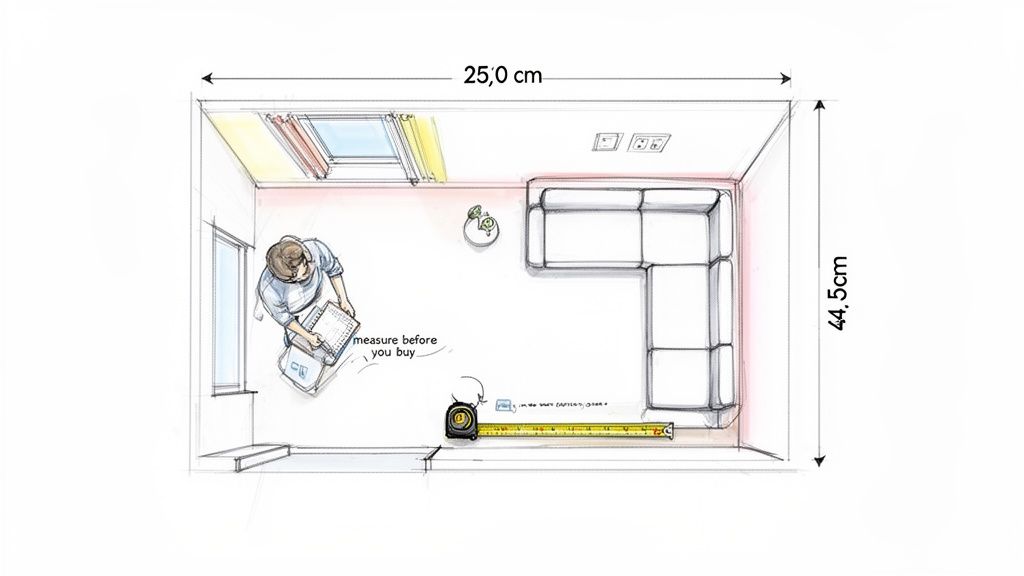
Before you fall in love with a piece of furniture, you need to know if it will truly work in your home. Taking the time to measure isn't just about crunching numbers; it's about crafting a space that feels intentional, comfortable, and uniquely yours.
This simple step eliminates the guesswork and ensures your investment is in furniture built for generations, not just a few seasons. It’s the foundation for creating a room that is both beautiful and functional.
Why Precise Measurements Matter
Properly measuring your room prevents those dreaded delivery-day surprises and costly mistakes. Getting your room measurements spot-on saves you from the massive hassle of furniture returns. In fact, industry reports show that improper sizing accounts for nearly one-third of all returns in the U.S. furniture market.
When you bring a detailed floor plan to our trusted local team in LaGrange, GA, we can immediately provide better guidance. Your sketch allows our design team to start curating options that fit your home and your lifestyle. This bit of prep work is a key part of knowing where to begin with your home design project.
The benefits of measuring first are crystal clear:
- Confidence in Your Purchase: You can be certain that the custom furniture you order will fit perfectly through every door, down every hall, and in its final spot.
- A Functional Layout: Proper measurements allow you to plan for comfortable traffic flow and ideal furniture placement, making the room far more livable.
- A Stress-Free Experience: Knowing your dimensions makes the shopping process smoother and more enjoyable, whether you're here in our Troup County showroom or working with our designers.
Gather Your Tools and Sketch a Basic Floor Plan
Before you start pulling out the tape measure, a little prep work goes a very long way. You don't need a professional drafting table or complex software, but grabbing the right tools will make the whole process smoother and, more importantly, accurate. Think of it as gathering your ingredients before you start cooking—it just guarantees a better result.
Most of what you’ll need is probably already tucked away in a drawer at home. The goal here isn't to create a masterpiece, but a simple, clear map of your room that you can bring with you when you visit our furniture store in LaGrange, GA.
Essentials for Accurate Measuring
A good measurement starts with a good tape measure. That flimsy, old tape you’ve been meaning to replace? It can lead to bad numbers and a whole lot of frustration. Here’s a quick rundown of what we recommend:
- A 25-Foot Steel Tape Measure: This is your MVP. A solid steel tape won’t stretch or sag over long distances, which means your wall-to-wall measurements will be spot on.
- Notepad and Pencil: Keep it simple. You’ll want to sketch out the room and jot down numbers as you go, and a pencil lets you make easy corrections.
- A Smartphone or Camera: Snap a few quick photos of the room from different angles. You'll be surprised how helpful it is to have that visual context later on.
If you have a larger home, especially one of the beautiful open-concept layouts you see around Pine Mountain or Troup County, a laser distance measurer is a fantastic investment. It gives you speed and pinpoint accuracy with just the push of a button.
Creating Your Bird's-Eye View Sketch
Now for the floor plan. This does not need to be a perfect architectural rendering. A simple, rough sketch is all you need to get started. Just imagine you're looking down into the room from above—that's the "bird's-eye view" you're going for.
Start by drawing the basic shape of the room, which for most of us is just a square or a rectangle. Don't stress about drawing it perfectly to scale yet. The crucial part is marking the locations of all the permanent fixtures.
This simple sketch is your most powerful tool when you visit our showroom. It immediately helps our team at the Watts Furniture & Mattress Interior Design Center visualize your space, making our complimentary in-store advice far more effective and personalized to your home.
Make sure you clearly indicate where all the doors and windows are. A pro tip: note which way the doors swing open—into the room or out into the hall—as this can really impact where you can place furniture. Add in other immovable features like fireplaces, built-in shelving, radiators, or any other architectural details. This sketch is the critical first step in figuring out how to design a living room layout that truly works.
Mastering the Measurements: Walls, Ceilings, and Entryways
With your sketchpad and tape measure in hand, you're ready to get down to the numbers that truly define your space. This is where a little bit of precision goes a long way, ensuring every piece of American-made furniture you fall in love with has a perfect spot waiting for it.
Let’s start with the basics: the room's length and width. Get an accurate reading by running your tape measure along the baseboard from one corner to the other on each primary wall.
But here’s a pro tip from our team, especially for older homes like those you find in historic LaGrange or Hogansville: walls are rarely perfectly straight. To account for any subtle bows or imperfections, measure each wall’s length in three different spots—low (near the floor), middle (waist-height), and high (near the ceiling). Always write down the shortest of the three numbers. It's your safest bet and prevents any unwelcome surprises.
Don't Forget to Look Up (And Check the Doorways)
Next, measure the vertical space from the floor to the ceiling. This measurement is absolutely critical if you're eyeing taller pieces like an elegant armoire, a towering bookcase, or a media center from our stunning Bassett collection. Just like with the walls, take this measurement in a few different places to catch any dips or rises in the ceiling height.
Now for the step that so many people forget—but it can make or break your delivery day. You have to measure every single point of entry your new furniture will have to navigate to get into the room. This is non-negotiable for a smooth and stress-free white-glove delivery.
Your path-clearing checklist should include:
- All Doorways: Measure both the height and the width of the door frame itself.
- Hallways: Jot down the width of any hallways your furniture will travel through.
- Staircases: Note the width of the stairs and, crucially, the ceiling clearance at the lowest point.
- Tight Corners: Be on the lookout for any sharp turns that could trip up a delivery team.
A standard interior doorway is usually only 30 to 32 inches wide. If that gorgeous sofa you’re considering is wider than that, it’s simply not getting through. A quick check here saves you from the "it looked smaller online" headache.
This simple flow chart captures the whole process, from grabbing your tools to sketching the layout.
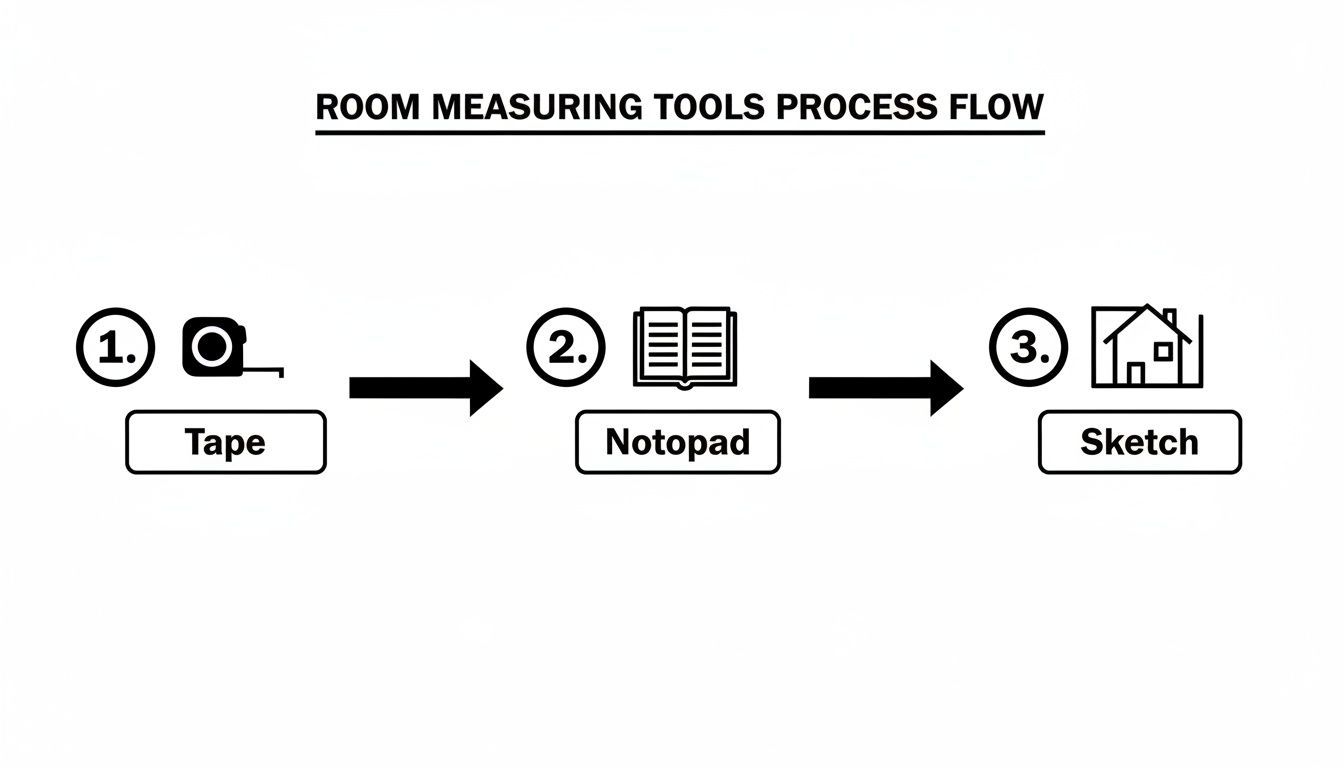
As you can see, it's a straightforward path from gathering supplies to sketching your space and taking down those all-important notes.
Why Every Single Inch Counts
This meticulous approach isn’t just about making sure a sofa fits. It’s about making smart, confident investments in your home. Historically, as home sizes in the U.S. grew, proper room measuring prevented over 15% of potential furniture delivery issues, a figure that corresponds with a rise in custom orders. This isn't just a trend; it's a shift toward creating intentional, personalized spaces that truly work.
By taking these steps, you’re doing more than just measuring walls—you're laying the groundwork for a home that perfectly supports your life. And if you're wondering how to size up the furniture itself, our guide on how to measure individual furniture pieces has all the tips you need.
Accounting for Obstacles and Planning Traffic Flow
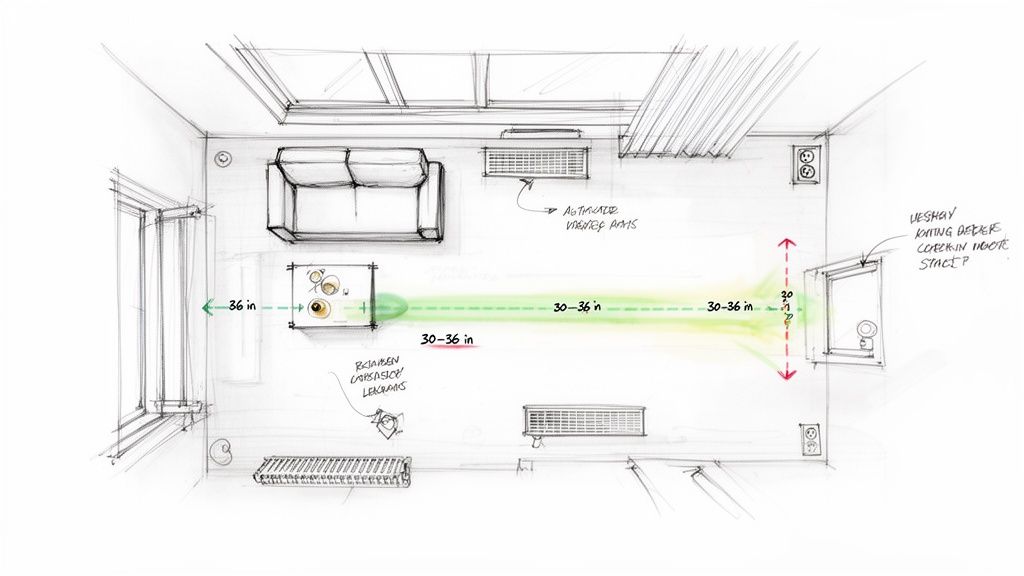
A room is so much more than just four walls. The real character—and the real constraints—come from the things you can't move. Windows, radiators, and outlets are the fixed elements that truly dictate how you can live in a space, and this is where your detailed sketch becomes your most valuable tool.
You'll want to add every single permanent feature to your drawing. Think of them as the non-negotiables of your room's layout, the things your new furniture will have to work with, not against.
Mapping Out the Unmovable
Start by sketching in all the windows. Don't just note their location; measure their width, height, and—this is the one people always forget—the distance from the floor to the bottom of the windowsill. That single measurement is what keeps you from buying a beautiful console table that ends up awkwardly blocking the view.
Next, it’s time to locate the other essential fixtures. These are the practical details that make a room truly functional.
- Radiators and Vents: Get their exact location and size. You don't want to block airflow with a big media unit, which can throw off your home's heating and cooling.
- Electrical Outlets: Mark every last one. This is how you plan where lamps or electronics go without having a tangle of extension cords running across the floor. It's especially important for pieces like Bassett recliners with power features.
- Light Switches and Thermostats: You need easy access to these. Make sure they won't end up hidden behind a tall new bookcase.
Getting this level of detail is exactly what helps you avoid the 'guesswork' of online shopping. When you bring this kind of map to us, we can give you guidance that's actually useful.
The Art of Planning Traffic Flow
Once you’ve mapped all the obstacles, you can start thinking about the most important element in a comfortable room: traffic flow. It’s simply the natural path people take to walk through the space. A room with good flow feels open and easy, while one with bad flow feels cramped and frustrating.
Getting this right is all about creating clear, unobstructed pathways. It’s what makes moving around your own home feel effortless.
As a rule of thumb, our design team tells clients to leave a main walkway of at least 30 to 36 inches wide. This gives you enough space to move freely without having to shimmy past furniture, making the entire room feel more welcoming.
This simple guideline can prevent the all-too-common mistake of buying furniture that's just a little too big for the space. An overstuffed room feels stressful, no matter its actual size. For more specific advice on arranging your main seating area, check out our guide on calculating the best placement for your sofa and television.
Taking the time to get these measurements right has a huge impact. Statistics show that while a staggering 42% of furniture shoppers cite poor measurements as the top reason they're unhappy with a purchase, using these techniques can boost your chances of getting the perfect fit by over 35%. It's a small step that makes a world of difference.
Bringing Your Vision to Life with Our Design Services
You’ve done the hard work—you have a solid sketch and a clear set of measurements in hand. Now for the fun part. This is where your careful planning meets our 65+ years of hometown expertise. Taking those numbers and turning them into a living room you’ll love for decades is what we do best.
Instead of getting lost in the guesswork of online shopping, bring your vision to our team. We believe in a hands-on approach that makes sure the final result is a perfect reflection of your style and fits your home flawlessly. This is how you create a space with furniture built for generations, not just a few seasons.
Complimentary In-Store Design Assistance
For many of our neighbors here in LaGrange and Troup County, all it takes is a little expert guidance to move forward with confidence. Bring your measurements and floor plan into our showroom at 212 Commerce Avenue in LaGrange, and let's talk.
Our designers offer Complimentary In-Store Design Assistance to help with those final, crucial details. This service is perfect when you need a hand with things like:
- Sorting through hundreds of fabric and leather options for that perfect custom La-Z-Boy recliner.
- Coordinating wood finishes for an American-made Kincaid dining set.
- Getting a second opinion on whether that sofa you love has the right scale for your room.
Our Premium Full-Service Interior Design
But what if you're planning something bigger, like furnishing an entire room from scratch or giving your whole home a refresh? Our Premium Design Service is your complete solution. We take your detailed measurements and translate them into a full-scale, professional design plan, removing all the stress and uncertainty from the process.
With our premium service, we handle it all—from space planning and furniture layouts to creating detailed mood boards that capture your vision. It’s true customization that reflects your home, not a mass-produced catalog. The best part? The initial design deposit is credited right back toward your 'made-for-you' furniture purchase.
Our goal is simple: to help you create a home you’ll be proud of for years to come. Whether you just need a quick color consultation or a complete room overhaul, you can learn more about our two-tier design model and find the perfect level of support for your project. Let us show you how we turn your hard work into a stunning reality.
Common Questions About Measuring for Furniture
Even with a perfect plan, a few questions always seem to pop up. Our customers in LaGrange, West Point, and Pine Mountain often run into the same little uncertainties after measuring their rooms. So, drawing on our 65+ years of experience, we’ve gathered the most common ones here to give you that final boost of confidence.
Think of this as a quick chat with a helpful neighbor who just happens to be a furniture pro. These are the small details that make a huge difference, turning a good layout into a great one.
How Do I Account for Baseboards and Trim?
This is a fantastic and very common question. When you're measuring a wall for a large piece like a media center or a sectional, always measure from baseboard to baseboard, not just wall to wall. That bit of trim can easily steal a crucial half-inch or more of space you thought you had.
For pieces that need to sit perfectly flush, like a bookcase, this is non-negotiable. It’s the secret to avoiding those awkward, unsightly gaps and getting that clean, built-in look. Forgetting the trim is one of those classic mistakes that can throw off an entire room's alignment.
What If My Room Isn't a Perfect Rectangle?
Plenty of homes, especially the beautiful older ones you find in communities like Hogansville, have charming layouts with angled walls, alcoves, or L-shapes. Don't let an odd shape intimidate you. The key is to break the room down into smaller, more manageable rectangles.
Just measure each rectangular section on its own and sketch them out, noting how they all connect. If you have an L-shaped living room, for example, just treat it as two separate rectangles. This trick not only makes measuring simpler but also helps our Interior Design Center team see opportunities for creative furniture arrangements—like a cozy reading chair in that alcove or a perfectly sized desk for an angled corner. It’s a chance to create unique zones within a larger space.
What's the Ideal Distance Between a Sofa and Coffee Table?
Getting comfort and function right often comes down to just a few inches. We’ve found the ideal distance between the edge of your sofa and your coffee table is between 16 to 18 inches.
This specific spacing is the sweet spot. It’s close enough to comfortably reach for your drink or a book, but it leaves just enough room to walk through without feeling squeezed. Any more, and the table feels disconnected from the seating; any less, and you'll be constantly bumping your shins.
This simple rule helps create a conversation area that feels cohesive and is genuinely easy to use. It’s one of those subtle but powerful guidelines our designers rely on to make a room feel just right. This is the kind of practical, expert guidance you receive with our Complimentary In-Store Advice—helping you build a space that works as beautifully as it looks, with furniture that feels like it was made just for you.
Ready to transform your space? Visit the Watts showroom at 212 Commerce Avenue in LaGrange to experience the comfort of La-Z-Boy in person. For more personalized help, book a consultation with our Interior Design Center today and let us help you curate a home you’ll love by visiting us at https://www.wattsfurniture.com.