Find Your Perfect Mattress with Our Guides

Ashley Furniture Mirror A Buyer’s and Styling Guide

You know the feeling. The sofa is in place, the rug works, the lamps are fine, and the room still looks flat. It doesn’t feel finished. It feels like it’s waiting on one last decision.
Most of the time, that missing piece is a mirror.
A good mirror doesn’t just fill wall space. It bounces light, softens a heavy furniture layout, and gives a room some life. That’s why an ashley furniture mirror ends up on a lot of shopping lists. Ashley Furniture, founded in 1970, now operates over 1,075 locations worldwide, which makes its mirror selection widely available and familiar to shoppers looking for practical home decor (Furniture Today coverage of Ashley’s scale).
That accessibility is the upside. The downside is that many people buy a mirror online, hang it too high, pair it with the wrong furniture, or choose a frame material that won’t age well in a Georgia home.
I’ve seen that happen plenty of times with homeowners around LaGrange, Troup County, West Point, Pine Mountain, and Hogansville. They’re not making wild design mistakes. They’re just missing a clear plan.
If you want a room to feel polished instead of pieced together, start with the mirror and make the choice on purpose. If you need inspiration for the bigger picture, this guide on how to create an eye-catching room is a smart companion to the mirror decisions below.
The Finishing Touch Your Home is Missing
A mirror earns its place when it solves a problem.
Maybe your entry feels narrow. Maybe your dining room gets nice evening light but still looks dull after sunset. Maybe your bedroom dresser wall feels heavy and blank. In each of those situations, a mirror does more than artwork usually can. It gives you reflection, brightness, and shape all at once.
Why mirrors work when a room feels off
Most rooms that feel unfinished have one of these issues:
- Too much visual weight: A solid wall of wood furniture, upholstery, or dark paint can make a room feel closed in.
- Not enough light movement: Lamps create pockets of light. Mirrors spread it.
- A missing vertical element: If everything in the room sits low, the eye needs something taller to travel toward.
That’s why I often tell shoppers not to treat a mirror like an afterthought. Treat it like equipment. It has a job.
A mirror should either brighten the room, balance the furniture, or create a focal point. If it does none of the three, skip it.
Why Ashley is often the starting point
Ashley mirrors are popular because they’re easy to find, easy to style, and available in a broad range of looks. For many homes, that makes sense. You can find full-length options, dresser mirrors, wall mirrors, and simpler frameless looks without turning the search into a full-time job.
That said, broad availability doesn’t automatically mean the mirror is right for your room. A mirror can be affordable and still be the wrong scale, wrong finish, or wrong material for your house.
That’s where experienced guidance matters. Not because decorating has to be complicated, but because a few practical choices make the difference between “good enough” and “that looks exactly right.”
Decoding Ashley Mirror Styles and Materials
Style is the easy part. Material is where people get in trouble.
A lot of shoppers choose an ashley furniture mirror based on the front view only. They like the shape, click order, and assume the rest will work itself out. It won’t. In Georgia, especially, material quality matters because humidity exposes weak construction faster than a showroom tag ever will.
Start with the shape
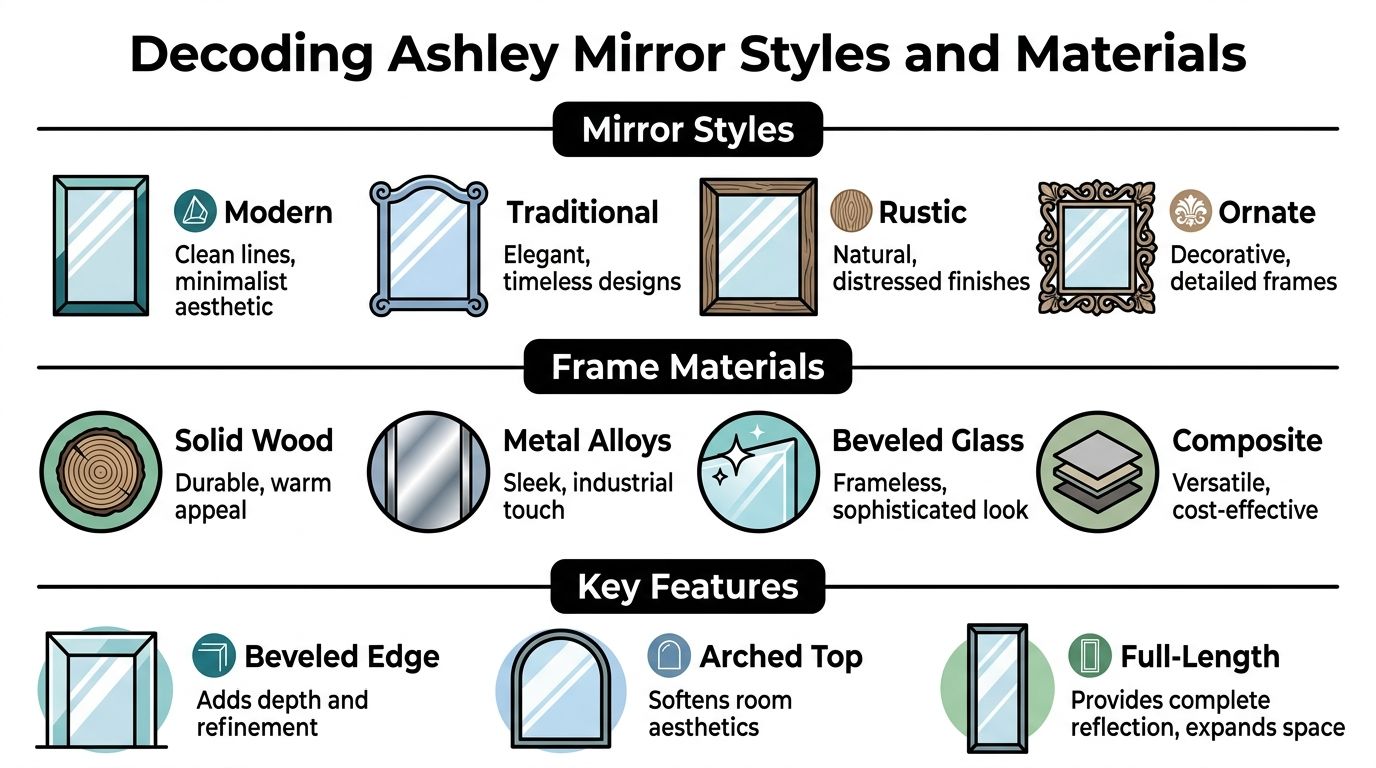
Here’s how I think about the main mirror styles.
- Arched mirrors soften a room. They’re useful around square furniture, straight-lined sectionals, and boxy case pieces.
- Rectangular mirrors are the most flexible. They work over dressers, sideboards, mantels, and console tables.
- Full-length mirrors help a bedroom, dressing area, or entry feel taller.
- Frameless or beveled looks lean cleaner and lighter. They’re useful when the room already has plenty of wood or decorative detail.
If your room feels stiff, choose a softer shape.
If your room feels busy, choose a simpler frame.
That one rule will save you from a lot of expensive second-guessing.
Then judge the frame honestly
You really need to look past the catalog photo.
Consumer reports and online forums point to a real information gap around mirror durability in humid climates. Some mass-produced mirrors using MDF or certain veneers have shown a higher incidence of frame delamination, which is worth considering for homeowners in places like LaGrange, GA (SohoMod category research on Ashley mirrors and durability concerns).
That doesn’t mean every engineered frame is bad. It means you shouldn’t buy blindly.
Use this quick material filter:
| Material type | What it gives you | What to watch |
|---|---|---|
| Solid wood accents | Warmth, character, better long-term feel | Usually higher cost |
| Composite or engineered frames | Wider style range, lower upfront cost | Can be more vulnerable in damp spaces |
| Metal frames | Clean lines, useful in transitional or industrial rooms | Finish should match nearby hardware |
| Beveled glass | Light visual weight, polished look | Needs careful placement so it doesn’t disappear on the wall |
My blunt advice on value
If the mirror is going in a powder room, bedroom, or any part of the home that deals with moisture swings, don’t shop by photo alone.
Ask:
- What is the frame made of
- Does the finish look convincing next to real wood furniture
- Will this still look good in a few years, not just this season
That’s the difference between decorative filler and furniture built for generations, not just a few seasons.
For a related look at mixed materials, this article on what you should know about metal accents helps when you’re coordinating mirror frames with lighting and hardware.
The Art of Size and Scale for Perfect Placement
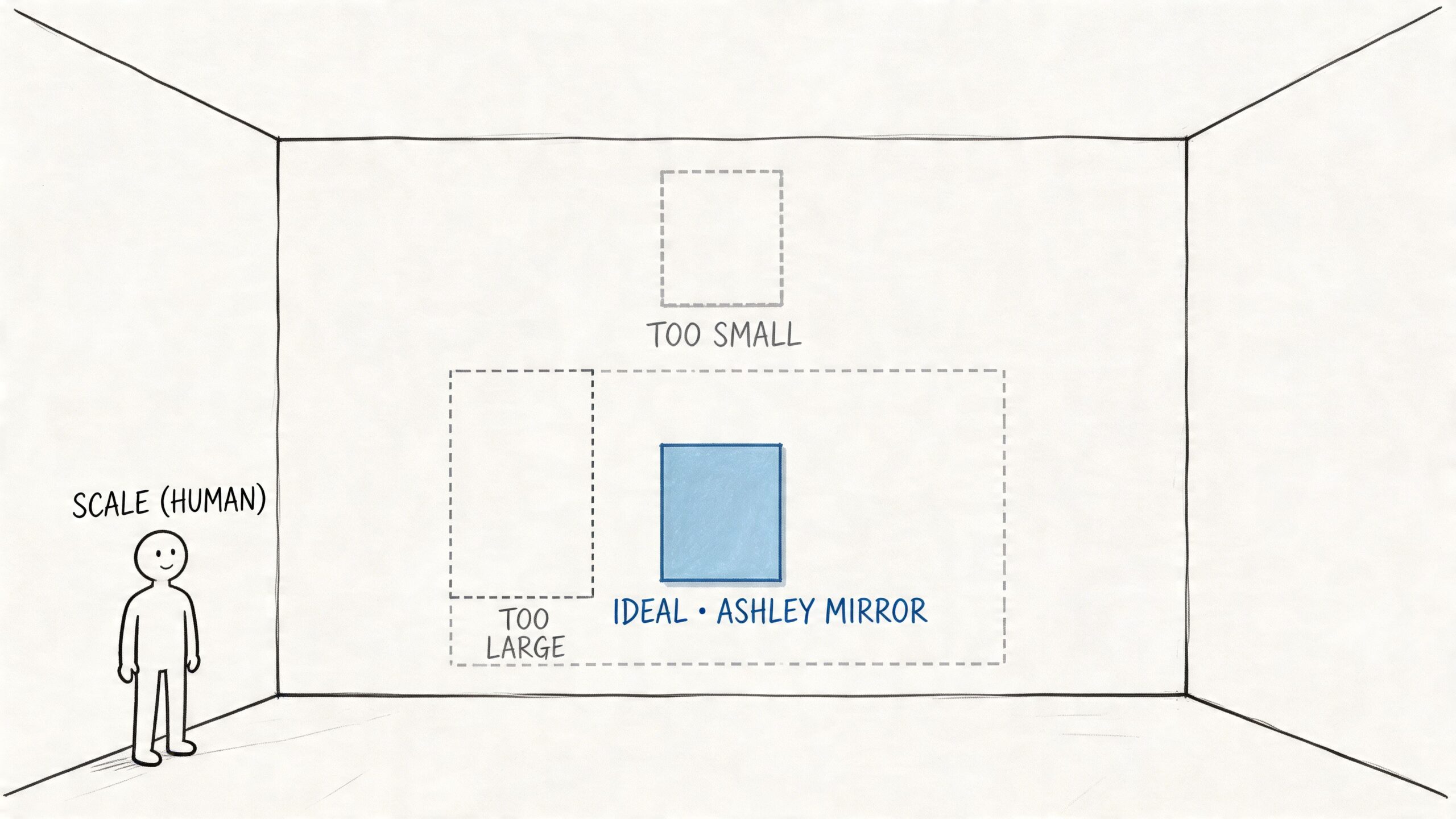
A beautiful mirror in the wrong size looks cheap fast.
That’s one of the most common decorating mistakes I see. The mirror isn’t ugly. It’s just too small for the dresser, too tall for the wall, or too narrow to hold its own over a console. Proportion matters more than people think.
The rule I use most often
For a wall mirror placed above furniture, aim for roughly two-thirds the width of the piece below it.
Not because design needs rigid math. Because this proportion usually looks balanced to the eye.
A few examples:
- Over a dresser, the mirror should feel connected to the case piece, not like a postage stamp floating above it.
- Above a console, leave enough breathing room on each side so the furniture still frames the mirror.
- Over a mantel, the mirror should support the architecture instead of overpowering it.
Practical rule: If you notice the empty wall more than the mirror, it’s probably too small.
What full-length mirrors need
Floor mirrors follow a different logic. You’re not matching them to a piece below. You’re managing footprint, traffic flow, and safety.
The Ashley Furniture Norigan Floor Mirror is built at 48 lbs, and that weight is part of its stability, not just its appearance. Its low center of gravity makes it more resistant to tipping in busy family spaces, which matters if you’re placing a leaning mirror in a bedroom, hallway, or entry where people pass by often (Norigan Floor Mirror details).
That’s an overlooked detail online. People focus on style and ignore the fact that a freestanding mirror has to behave well in a real home.
A quick placement checklist
Before you buy, answer these questions:
- What will the mirror reflect: A window, a lamp, a pretty wall, or clutter?
- How close is traffic: A narrow hall needs a slimmer visual profile than a roomy bedroom wall.
- Is the height comfortable: You shouldn’t have to crane your neck to use it.
- Does it compete with nearby furniture: If the room already has a dramatic headboard or tall hutch, keep the mirror quieter.
If you’re working with a tight room, this guide on how to make a small room feel big is useful because mirror scale and room scale go hand in hand.
That's why Complimentary In-Store Advice in an Interior Design Center is so helpful. You bring in a photo, a few measurements, maybe a finish sample, and you avoid the guesswork of online shopping before another oversized return lands on your porch.
Choosing the Right Mirror for Every Room
A mirror shouldn’t be chosen in isolation. It should answer the room’s biggest need.
Some rooms need more light. Some need more height. Some need a stronger focal point. Once you think that way, choosing the right ashley furniture mirror gets much easier.
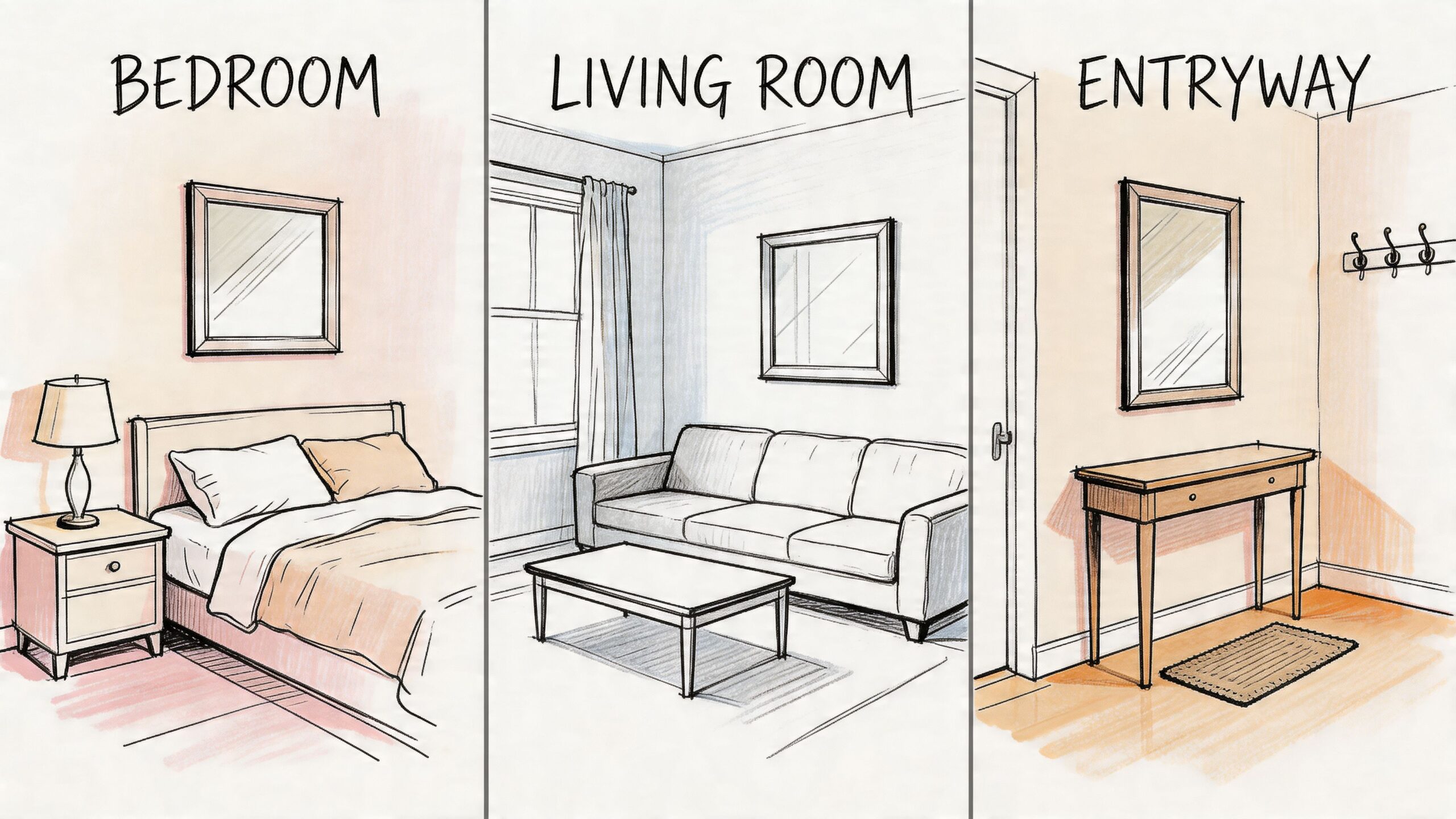
Living room
In a living room, a mirror usually works in one of two spots. Over a mantel, or above a console or sofa table behind living room sectionals.
If the room has heavy upholstery, wood tables, and darker textiles, use the mirror to break that up. A cleaner frame or beveled edge can keep the seating area from feeling too dense.
For living rooms, I recommend:
- Over a mantel: Choose a mirror that echoes the width and weight of the fireplace.
- Behind a sectional: Use a shape that softens the furniture profile if the sofa has strong square arms.
- Across from a window: Good move, as long as the reflection is attractive and not harsh.
Dining room
Dining rooms benefit from mirrors at night more than people expect.
A mirror reflecting a chandelier or lamp glow adds warmth without adding more furniture. It also makes the room feel more layered when the table is set and guests are seated.
This is one place where ornate or traditional Ashley styles can work nicely, especially if the dining furniture is straightforward and needs a little lift.
In a dining room, a mirror should catch light. If it only reflects an empty wall, you’re wasting the placement.
Bedroom
Bedroom mirrors need function and calm. They don’t need drama for drama’s sake.
The Ashley Furniture Realyn Bedroom Mirror is a good example of a dresser mirror scaled for practical use. It measures 44" W x 40" H, and its 48.0 lb weight helps it stay stable when attached, which matters for a piece used every day (Realyn Bedroom Mirror specifications).
That kind of mirror works because it’s tied to the furniture, not floating as an unrelated accent.
For bedrooms, keep these guidelines in mind:
- Above a dresser: Match the visual width of the case piece.
- Leaning in a corner: Only if you have enough floor space and a wall that won’t make the room feel cramped.
- Near the bed: Avoid placing a mirror where it creates visual chaos from every angle.
Entryway
An entry mirror should do two things well. Let you check yourself on the way out, and make the entrance feel more open.
A tall, simple mirror works well here, especially with a bench or narrow console. If your entry is tight, don’t crowd it with a thick frame and bulky table combination.
Bathroom and humid spaces
Now for my personal take. If moisture is a regular factor, be picky. Don’t assume every decorative frame belongs in a damp setting.
Some shoppers want one consistent look across the house, but bathrooms and humid corners demand more discipline. If you’re pairing mirrors with American-made furniture, bedroom pieces, or a custom vanity area, choose materials that can keep up with everyday life, not just the first photo.
Integrating Mirrors with High-Quality Custom Furniture
You buy a mirror you like, bring it home, hang it over a beautiful custom piece, and the room still feels off. The issue usually isn't price. It's coordination. A mirror can be modestly priced and still look right with better furniture, but only if the proportions, finish, and style are working together.
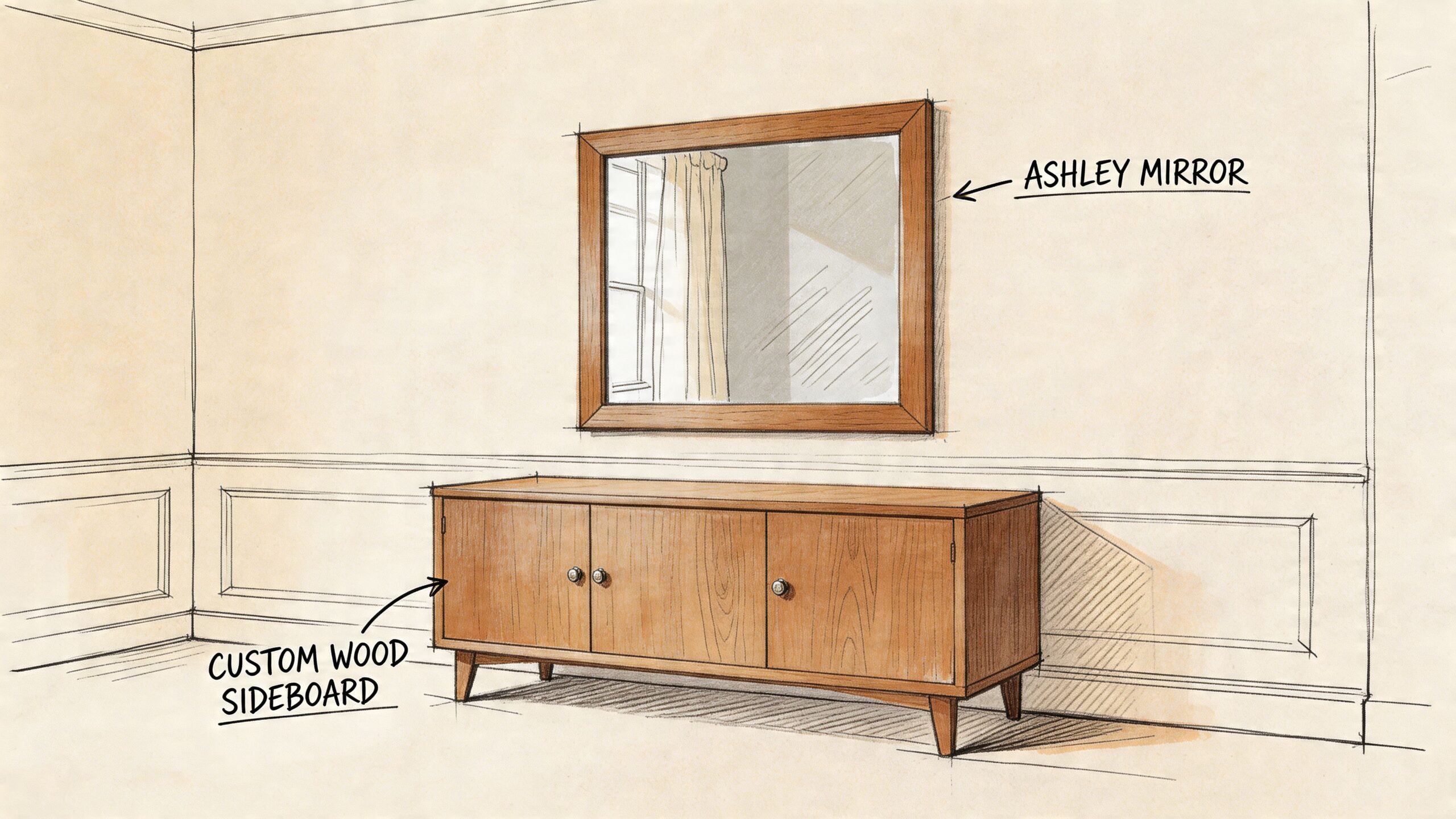
That pairing matters more than many stores admit. Shoppers often find an accessible mirror first, then struggle to make it live comfortably with a better sofa, sideboard, bed, or recliner. A good design plan fixes that. It turns the mirror into a supporting piece instead of a random add-on.
How to make mixed brands look intentional
Start with the larger furniture and let the mirror support it.
- Match undertones, not exact color: Warm wood with warm wood. Cooler gray-browns with cooler gray-browns.
- Repeat one finish on purpose: If the room already has black metal, aged brass, or brushed nickel, carry that into the mirror frame or nearby hardware.
- Watch visual weight: A heavy farmhouse mirror can overpower a clean-lined custom console. If one piece is bold, keep the other calmer.
- Keep the style family close: Traditional, transitional, rustic, and modern can mix, but they still need a common thread.
Good custom furniture earns its keep through its customizable features. You can choose the wood tone, fabric, leather, scale, and details on the main pieces, then use the mirror to complete the composition. That gives you more control than buying a whole room from one mass-market collection and hoping it all ages well.
A few combinations work especially well:
- An Ashley mirror above a custom dining sideboard in a coordinated wood tone
- A simpler framed mirror paired with a custom-made bedroom dresser in a better finish
- A decorative mirror used to soften the lines around custom upholstery or a quality recliner
The goal is a room that feels collected, not copied.
That’s why design help matters. A mirror may be the smaller purchase, but the furniture around it sets the standard for the room. If you want a practical starting point, custom furniture made simple lays out how to choose pieces with the right scale, finish, and function before you add accents.
For homeowners in LaGrange, Pine Mountain, and across Troup County, a design team can prevent expensive mismatches. The Premium Design Service at an Interior Design Center helps with layouts, mood boards, and finish coordination, with the deposit credited back toward the purchase.
One local option for putting those elements together is Watts Furniture & Mattress, which offers mirrors, customizable upholstery, and design assistance in the same buying process.
A Simple Guide to Hanging and Installation
A mirror that’s styled well but installed poorly still fails.
Crooked placement, weak anchors, or the wrong hanging height can ruin the whole effect. And with heavier mirrors, bad installation can also become a safety issue.
What you need before you start
Gather these first:
- Tape measure
- Level
- Pencil
- Stud finder
- Appropriate wall anchors
- Drill or screwdriver
- A second person if the mirror is heavy
Don’t eyeball it. That’s how mirrors end up an inch off-center, and somehow your eye goes straight to it every single time you enter the room.
The basic process
- Measure the furniture below, if there is one.
- Mark the center point on the wall.
- Find studs if possible.
- If you can’t hit a stud, use hardware rated for the mirror and your wall type.
- Mark both hanging points carefully.
- Level before you commit.
- Lift and secure with help.
The right hanging height usually keeps the mirror visually tied to the furniture below it. Too high and it floats. Too low and it feels cramped.
When to call in help
If the mirror is large, unusually heavy, or going on a tricky wall surface, professional installation is the smart choice.
That’s also where white-glove delivery and setup earns its keep. Some homeowners love DIY. Others would rather have the piece placed, assembled, and secured correctly the first time. Both approaches are fine. What matters is that the mirror ends up safe and straight.
For a practical companion to the basics, this step-by-step guide to hanging your picture with precision covers the kind of measurement discipline that also applies to mirrors.
Your Partner for a Home Built to Last
You get the mirror home, hang it, and then the room still feels off. Usually the problem is not the mirror alone. It is that the piece was chosen in isolation, with no clear plan for the furniture, lighting, and finishes around it.
A mirror should earn its wall space for years, not just fill a blank spot this season. Start with three standards. Pick a style that fits the architecture and furniture you already own. Choose materials that can handle daily life and humidity without looking tired too soon. Make sure the mirror works with the room as a whole, especially if you are pairing an Ashley Furniture mirror with better-built pieces that deserve more than a quick catalog match.
That is the primary opportunity here. An accessible mirror can absolutely work in a polished home. The difference is how you use it. Pair a simple mass-market mirror with American-made case goods, custom upholstery, or a bedroom set chosen for long-term comfort and scale, and the room feels intentional instead of pieced together.
Good design help saves money. It keeps you from buying a mirror twice, choosing a finish that fights the wood tones in your dresser, or settling for a size that looks skimpy over a substantial piece. Watts Furniture & Mattress has served LaGrange families for decades, and that kind of experience matters when you are mixing quick-ship decor with custom furniture meant to last.
Support after the sale matters too. Delivery, setup, service help, and honest design guidance make the difference between a room that is merely furnished and one that works well.
If you want a mirror to fit into a home built for the long haul, get a second set of trained eyes on the room. Visit the showroom at 212 Commerce Avenue in LaGrange to compare finishes, test comfort, and see how mirrors, fabrics, wood tones, and custom options work together before you bring anything home.