Find Your Perfect Mattress with Our Guides

Placing Furniture In Living Room: Expert Tips For 2026


Most living rooms don’t start with a furniture problem. They start with a planning problem.
A sofa looks right in the showroom, then feels too deep at home. A chair blocks a doorway. The TV ends up too high, the rug too small, and suddenly the room feels off even though every piece looked good on its own. That’s why placing furniture in living room spaces has less to do with instinct than is commonly believed.
Good layouts feel easy because the hard decisions happened first. The room supports conversation, daily traffic, movie nights, naps, pets, kids, and all the little habits that make a house feel lived in. When the placement is wrong, you feel it every time you walk through the room.
Your Living Room Layout Starts Before the Furniture Arrives
You feel the difference before anyone sits down. In a well-planned living room, the walkway stays clear, the sofa fits the wall, and the room works the way your family lives. In plenty of LaGrange-area homes, especially older houses with offset windows, narrow entries, or a fireplace that is not centered, that result starts long before delivery day.
Start with a measured plan, not a guess. Measure the room, then mark the fixed features that shape every layout decision: doors, windows, vents, floor outlets, fireplaces, and any opening that needs to stay usable. In homes around LaGrange, Pine Mountain, and Hogansville, those details often decide whether a room feels settled or awkward.

Measure the room and the furniture
Room size alone is not enough.
Measure the pieces you own, and get the exact dimensions of anything you plan to buy. Length matters, but depth often causes the primary trouble. A deeper sofa can crowd a walkway fast, and that shows up often in older Georgia living rooms that were built for a different scale of furniture than many current styles.
I tell clients to track four things first:
- Wall lengths: Include alcoves, columns, and bump-outs.
- Openings and swings: Note where doors open and where traffic naturally passes through.
- Furniture depth and reach: Reclining pieces, console tables, and chaise extensions need more room than the tag suggests.
- Sightlines: Check what is visible from the entry, the main seat, and adjoining rooms.
Practical rule: If you cannot sketch the room to scale, you are not ready to place furniture yet.
Graph paper works. So does a basic planning app. The goal is simple. See the whole room clearly before a single piece arrives.
For a solid starting point, this room layout planning guide from Watts Furniture helps you organize measurements and avoid common fit problems.
Use design help before you buy
Good furniture cannot rescue a poor layout. If the scale is off, the room will keep fighting you.
That is one reason our Interior Design Center matters. Some households need quick, in-store guidance on size, fabric, and finish. Others need a full room plan because they are combining new seating with family pieces, making space for grandparents and grandkids, or trying to solve an older floor plan that never handled modern TV viewing very well.
At Watts, those needs are handled in two practical ways:
- Complimentary In-Store Advice: Useful for narrowing down sizes, comparing options, and getting the room pointed in the right direction.
- Premium Design Service: Better for full layouts, mood boards, and a purchase plan, with the deposit applied to your order.
That service is especially useful when you are choosing American-made furniture from lines like La-Z-Boy and Bassett, where size, configuration, and finish options give you more control. A sectional that is suited to your room beats a bigger piece that only looks good on a showroom floor.
The best living rooms rarely happen by accident. They are measured, tested, and planned for the people who use them every day.
Establish Your Room’s Focal Point
You can see the problem as soon as you walk in. The fireplace looks like the natural center of the room, but the family watches TV every night, the windows bring in the best light, and every seat is trying to answer to a different wall.
A living room settles down once one feature takes the lead. That focal point could be a fireplace, a media wall, a large window, or built-ins with real architectural presence. Once that choice is clear, the rest of the layout starts making sense.
Pick the feature that matches real life
The right focal point is not always the prettiest one. In many LaGrange homes, especially older houses, the original focal point was a fireplace. Daily life has changed. If the room is used for movie nights, ball games, and after-dinner TV, the furniture should respect that instead of pretending otherwise.
That trade-off comes up often in our Interior Design Center. A homeowner wants the charm of a traditional fireplace arrangement, but also needs comfortable sightlines to the television and enough seating for visiting family. In those cases, the best plan is usually a room that gives the main seating a clear relationship to both features, with one established as primary and the other treated as support.
A few reliable starting points work well:
- Fireplace first: A good choice when the fireplace is centered, attractive, and used often.
- Media first: A practical choice for households that spend most evenings watching TV.
- Window or built-ins first: A strong option when the view, natural light, or millwork gives the room its character.
Rooms feel calmer when the seating acknowledges what matters most.
Avoid competing priorities
The layouts that feel unsettled usually have more than one feature asking for attention. A fireplace on one wall and a large TV on another can split the room in half. Furniture then lands in the middle with no clear reason for being there.
That is where scale and customization help. A Bassett media console built to suit the wall can keep the television from overpowering the room. A pair of well-proportioned chairs can frame a fireplace without blocking the view across the space. With La-Z-Boy and Bassett, size and configuration options make it easier to solve these mixed-use rooms cleanly, especially in homes where the original layout never anticipated modern screens or multi-generational gathering.
If TV placement is part of the decision, this guide to optimal TV positioning helps you sort out viewing angles before you commit to a console, sectional, or chair placement.
One more rule is worth keeping in mind. Every good seat should feel included. If one recliner gets the perfect view and the sofa feels secondary, the room will never feel fully resolved. The focal point does not need to dominate the space. It needs to lead it.
Create Natural Flow with Smart Spacing
A living room usually feels right or wrong the moment you walk through it. In many LaGrange homes, especially older ones with narrow entries, off-center fireplaces, or a path that cuts straight through the seating area, spacing decides whether the room feels easy to live in or constantly in the way.
Follow the spacing rules that matter
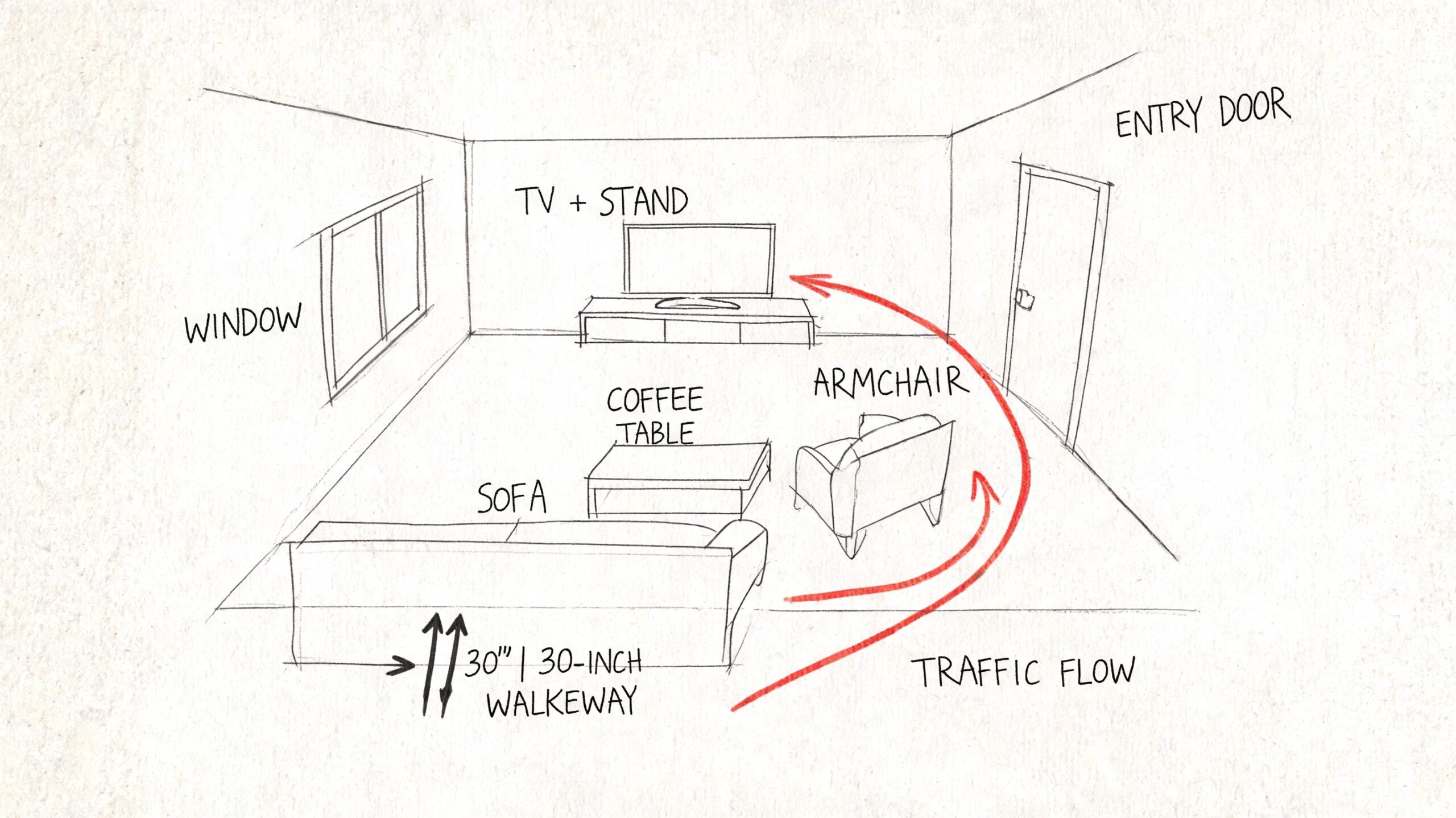
Good layouts leave clear room for both movement and conversation. A coffee table should sit close enough to reach from the sofa without forcing anyone to squeeze past it. Main walking paths need enough width for someone carrying laundry, a grandchild moving between rooms, or two people passing without bumping knees into furniture.
These guidelines hold up in real homes:
| Area | Recommended spacing |
|---|---|
| Sofa to coffee table | About 18 inches |
| Primary walkway | About 30 to 36 inches |
| Main circulation path | About 32 to 40 inches |
| Seating across from seating | Roughly 3.5 to 10 feet |
The goal is comfort, not perfect math. If seats are too close, the room feels cramped. If they are too far apart, conversation starts to feel formal and strained.
What works in practice
One of the most common mistakes is pushing every piece to the perimeter and leaving a big empty center. That can make a room look larger in photos, but it rarely helps a family use the room well. The better approach is to build a clear seating zone and protect the natural path through the space.
A few placement habits make a noticeable difference:
- Float the main seating when the room allows it: A sofa pulled off the wall often gives the room better shape and keeps traffic from cutting through the conversation area.
- Keep the walking route obvious: People should be able to cross the room without weaving around an ottoman or brushing the arm of a recliner.
- Leave a little breathing room around larger pieces: Even a small gap between the wall and a sofa can make an older living room feel less crowded.
- Use the right size furniture for the path you need: In tighter rooms, a slimmer sofa, smaller-scale chair, or round table often works better than forcing a bulky piece into place.
I see this often with multi-generational households. One person wants a full reclining sectional, another wants open floor space for visiting grandkids, and the room has to support both. That is where customization helps. La-Z-Boy sectionals with modular pieces or Bassett tables in the right proportions can solve spacing problems far better than guessing with standard sizes.
Tight rooms respond well to better placement, better scale, and fewer obstacles.
If you are still deciding between a sectional, two chairs, or a larger coffee table, this room measuring guide for furniture will help you avoid the spacing mistakes that are hardest to fix after delivery.
At Watts, our Interior Design Center helps families work through these details before anything arrives at the house. That matters in homes with tricky Georgia layouts, because the right spacing is not just about looks. It lets every seat function properly, keeps the room easy to move through, and gives well-made furniture the room it needs to do its job.
Achieve Balance with Scale Rugs and Lighting
A living room can be measured well and still feel off once everything is in place. I usually see the problem in two spots. The rug is undersized, or the lighting leaves the seating area feeling uneven after sunset.
Scale is what makes the arrangement feel settled. A sofa and chairs should relate to each other in visual weight, not just fit inside the room. In many LaGrange homes, especially older ones with modest footprints or rooms added on over time, that balance takes more care than people expect. A deep sectional paired with a small rug can make the whole room look cramped. A pair of delicate chairs beside a substantial sofa can make the seating group feel pieced together instead of planned.
The rug should hold the entire conversation area together. In most rooms, that means at least the front legs of the main seating pieces sit on the rug. If the rug floats alone in the middle, the furniture looks disconnected. If it runs too close to every wall, the room can feel wall-to-wall and heavy.
Lighting needs the same kind of proportion. One ceiling fixture rarely handles everything a living room has to do. Families use these rooms for visiting, reading, watching TV, homework, and holiday overflow, sometimes all in the same week. Good lighting supports those shifts with layers: general light for the room, focused light near seating, and softer accent light to keep corners from going dark. For practical ideas, this living room lighting guide from Watts is a helpful reference.
Furniture also has to earn its square footage. That matters in multi-generational homes, where one room may need easy-to-reach seating for grandparents, durable surfaces for grandchildren, and enough flexibility for guests. A custom La-Z-Boy sectional in the right depth, a Bassett cocktail table sized to the seating group, or an ottoman that can shift between footrest and extra seating usually works better than forcing in a piece that is too large.
At Watts, our Interior Design Center helps families compare these proportions before they commit. That saves a lot of trial and error. With customizable, American-made options from La-Z-Boy and Bassett, it is easier to get the scale right from the start and build a room that feels balanced in daylight and after dark.
Solving Layout Puzzles for Common Georgia Homes
Not every room gives you a clean rectangle and a centered fireplace. In this part of Georgia, plenty of homes come with narrow proportions, older trim details, angled walls, or openings that interrupt the obvious furniture wall.
That doesn’t mean the room is difficult. It means the layout has to respond to the house instead of copying a catalog photo.

Long and narrow rooms
A long room usually goes wrong in one of two ways. People either line everything up along the walls, which creates a bowling-alley effect, or they overfill the center and kill the walkway.
A better solution is to break the room into functional zones. One end can hold the main seating group. The other can become a reading corner, desk spot, or game table area. The furniture should suggest those uses without erecting barriers.
Helpful moves include:
- Floating the sofa: This can create a clean walkway behind it.
- Using a narrower console or bench: Good for transition zones.
- Choosing oval or round tables: Easier to move around than sharp-cornered pieces in tight paths.
Older homes and awkward angles
Historic homes around LaGrange often have the kind of details people love and the kind of dimensions they don’t expect. Slanted walls, off-center windows, uneven floors, and unusual traffic paths all affect placement.
A key challenge in non-standard rooms is flexibility. According to this article on layout constraints in older and rental homes, 68% of renters feel "trapped" by layouts, and 42% cite slanted walls. That lines up with what many people experience in older housing stock where permanent changes aren’t realistic.
In awkward rooms, the goal isn’t symmetry. The goal is stability, comfort, and a path that makes sense.
That often means using pieces that can pivot with the room:
- Swivel chairs: They handle TV viewing and conversation without forcing a rigid angle.
- Modular seating: Easier to adapt when a wall doesn’t behave like a normal wall.
- Slim-profile sofas: Better for cottages, bungalows, and tighter floor plans.
Open-concept and multigenerational setups
Open rooms create a different issue. There’s plenty of space, but not enough definition. Furniture has to do the zoning.
A sectional can separate the living area from a dining space. A bookcase can screen a work corner without making the room feel shut in. Accent chairs can turn toward the sofa for conversation or rotate toward another part of the house when the room is busy.
Thoughtful product selection matters more than sheer quantity. This living room furniture guide is useful for comparing profiles, seating types, and room needs before you commit.
One practical option some households use is Watts Furniture & Mattress for layout planning tied to delivery and in-room placement, especially when the room has a preplanned arrangement and heavier pieces need to land in the right spot the first time.
Mass-produced furniture often struggles in rooms like these because the dimensions are fixed and the profiles are generic. Custom furniture gives you more control. A made-to-order Bassett sofa, Kincaid occasional piece, or configurable living room sectional can solve the room you have, not the one in the ad.
Quick Guide The Dos and Donts of Arranging Furniture
When you’re in the middle of moving pieces around, a short checklist helps more than a long theory.
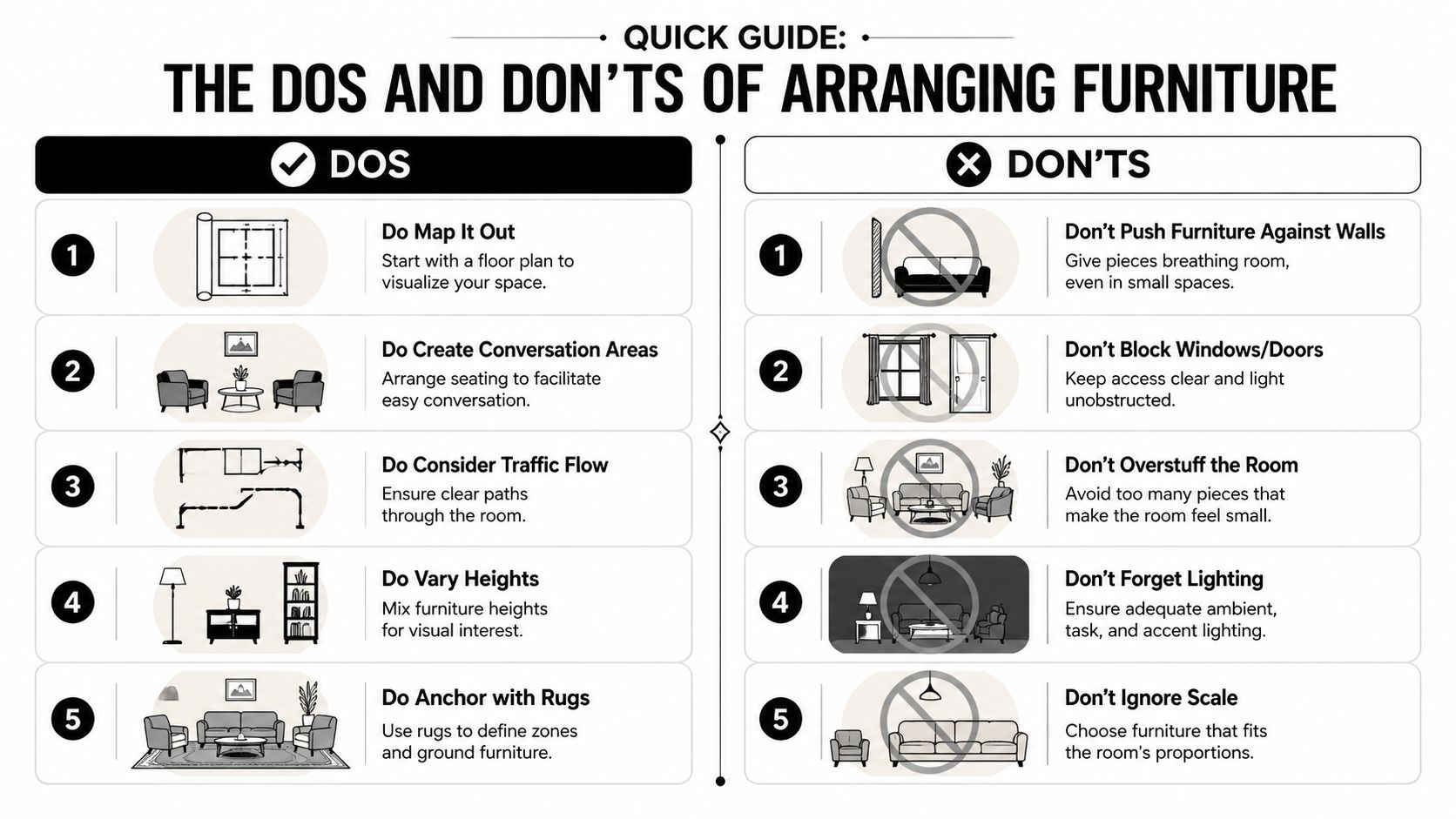
Keep this checklist nearby
Do
- Map it out first. A floor plan prevents expensive missteps.
- Create conversation areas. Seats should relate to each other, not just to the walls.
- Protect the traffic flow. Walking paths need to feel natural.
- Mix heights. Sofas, tables, lamps, and case pieces should create rhythm.
- Anchor with rugs. The rug should support the furniture grouping.
Don’t
- Push everything against the wall. Breathing room usually improves the room.
- Block windows or doors. Good placement keeps light and access open.
- Overstuff the room. More pieces rarely solve a layout problem.
- Forget lighting. A room needs layered light to function well.
- Ignore scale. A beautiful piece still has to fit the room.
The best rooms don’t look copied from a mass-produced catalog. They look considered, comfortable, and ready to be lived in.
Create a Living Room You Love with Watts Furniture
A good living room layout supports real life. It makes conversation easier, keeps movement simple, and gives each piece a reason to be there. When the room is measured well, anchored by a clear focal point, and spaced correctly, it starts to feel settled instead of improvised.
That’s the difference between buying furniture and building a home. Quality matters, but placement matters too. The strongest rooms combine both, especially when you’re choosing American-made furniture, comparing living room sectionals, or trying to make one room serve a growing family in LaGrange, West Point, Pine Mountain, or across Troup County.
The goal isn’t perfection. It’s a room that works today and still works years from now, with furniture built for generations, not just a few seasons. Professional planning, white-glove delivery, and real customization help remove the trial and error that causes so much frustration.
Visit Watts Furniture & Mattress at 212 Commerce Avenue in LaGrange to experience the comfort of La-Z-Boy in person. Ready to transform your space? Book a consultation with our Interior Design Center today and let us help you curate a home you’ll love.