Find Your Perfect Mattress with Our Guides

Faux Leather Decorative Pillows: A Complete Buying Guide


You’re standing in your living room, looking at a good sofa that still feels unfinished. The shape is right. The rug works. The coffee table is doing its job. But the room needs one more layer so it feels collected instead of flat.
That’s where faux leather decorative pillows often earn their place.
They add contrast without making a room fussy. They bring in a refined aesthetic, a little structure, and a surface that’s often easier to live with than softer woven fabrics. For busy homes, that matters. If you’ve got kids dropping snacks, pets claiming the best seat in the house, or a family room that sees regular use, the right accent pillow has to do more than look pretty.
A lot of homeowners around LaGrange, West Point, Pine Mountain, and across Troup County want the same thing. They want their home to feel polished, but they don’t want to baby every piece in it. Faux leather sits right in that sweet spot.
It also helps solve a common decorating problem. Many rooms already have enough softness. Upholstered sofas, woven throws, plush rugs, and fabric curtains can all blend together. A faux leather pillow breaks that up with a smoother, more defined texture. If you’ve been drawn to clean, layered spaces, you can see that look in this guide to creating an effortless urban look.
An Introduction to Effortless Style
A good decorative pillow should do two things at once. It should improve the look of the room, and it should make sense for the way you live.
That’s why faux leather has become such a dependable choice. It gives you the warm, rich look people often associate with leather, but in a form that works well as an accent. You can use it on a sofa, recliner, bed, or bench without making the room feel too heavy.
Why this material feels current
Faux leather decorative pillows fit the way many people decorate now. Homes are less formal than they used to be, but people still want rooms to feel intentional. These pillows help bridge that gap.
They look refined without feeling precious. A single cognac pillow can warm up a gray sectional. A black one can sharpen a neutral bedroom. A soft camel tone can make a cream chair feel more grounded.
A pillow may be a small piece, but it can change how every larger piece around it reads.
Where people usually get stuck
Most confusion starts with one simple question. Is faux leather going to feel cheap?
Sometimes, yes. Poorly made versions can look stiff or shiny. Better ones feel smoother, softer, and more refined. That difference is why it helps to understand the material before you buy.
Another sticking point is scale. Faux leather has visual weight. That means one pillow can make a stronger statement than a patterned cotton pillow of the same size. You usually need fewer of them.
Understanding the Allure of Faux Leather Pillows
Faux leather has come a long way from the stiff vinyl look many people remember. Today, it often feels softer, looks more convincing, and works in far more interiors than it did years ago.
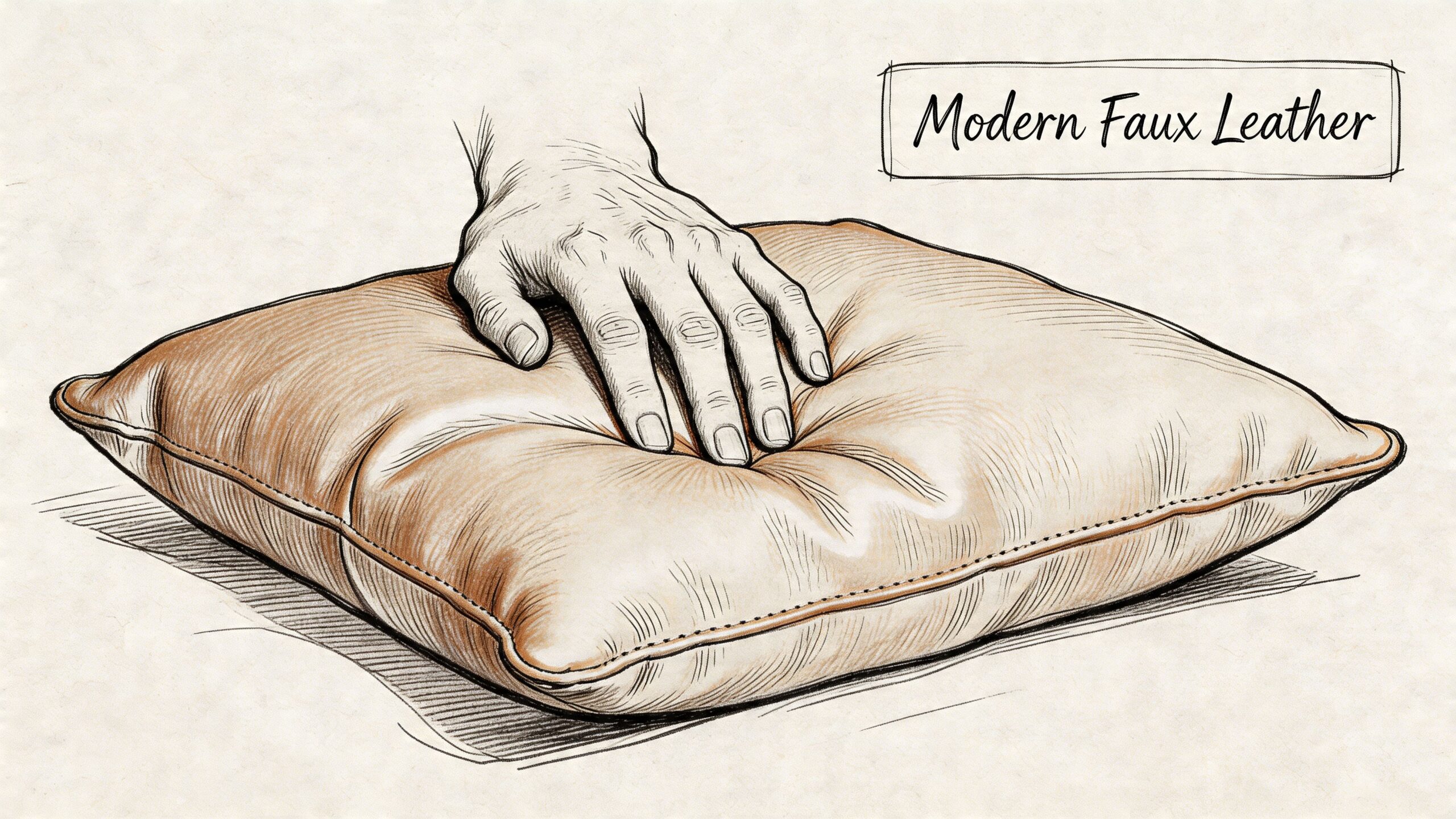
Most faux leather used for pillows is made from polyurethane (PU) or polyvinyl chloride (PVC) applied over a fabric base. That construction gives it a smooth, leather-like surface without using animal hide. For many shoppers, that combination of appearance and practicality is exactly the appeal.
Why more homeowners are choosing it
Part of the rise comes down to style. Faux leather decorative pillows add depth in a way flat fabric sometimes can’t. They catch light differently, they create contrast quickly, and they make a sofa or bed feel more layered.
Part of it is also consumer preference. Global sales of synthetic leather products reached approximately $45.6 billion in 2022, and a 2020 Nielsen survey found that 68% of U.S. consumers prefer vegan materials for home furnishings, according to Grand View Research’s synthetic leather market analysis.
Those numbers help explain why faux leather moved from niche accent to mainstream decorating staple.
What people like about the look
Faux leather decorative pillows tend to work because they do several jobs at once:
- They add structure to soft seating areas that need visual balance.
- They bring warmth through shades like cognac, saddle, camel, and chocolate.
- They simplify color schemes because solid faux leather often reads as a neutral.
- They cross style lines better than many trend-driven accents.
A sleek square faux leather pillow can look right at home in:
- Modern spaces with clean-lined sectionals
- Rustic modern rooms with wood tones and cream upholstery
- Industrial interiors with black metal and weathered finishes
- Traditional rooms that need a crisp accent to keep them from feeling overly formal
Why it doesn’t feel dated
Older faux materials often had one giveaway. They looked too glossy or too rigid.
Newer options are often textured, matte, or lightly pebbled. That makes them easier to blend with woven fabrics, wood, and performance upholstery. Instead of shouting for attention, they can subtly sharpen the room.
Practical rule: If a faux leather pillow feels cold, stiff, and overly shiny in the store, it will usually look that way at home too.
The best ones don’t try to fool you into thinking they’re antique leather. They offer a clean, usable version of that look.
Comparing Faux Leather with Real Leather and Fabric
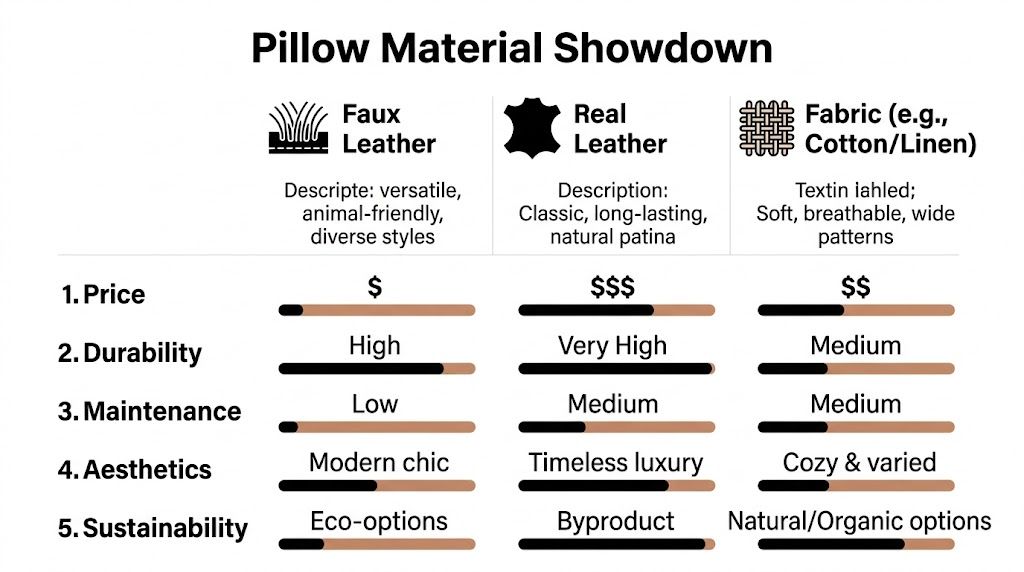
If you’re deciding between faux leather, genuine leather, and traditional fabric, the answer usually depends on how the pillow will be used. No material wins every category.
The trick is to match the material to the room, the people using it, and the level of upkeep you’re comfortable with. That’s how you avoid the guesswork of online shopping and make a choice that still feels right months from now.
Faux Leather vs. Real Leather vs. Fabric Pillows
| Attribute | Faux Leather | Genuine Leather | Fabric (Cotton/Linen/Velvet) |
|---|---|---|---|
| Price | Usually lower than real leather | Usually highest | Varies widely |
| Surface feel | Smooth, structured, often cool to the touch | Natural, supple, develops character over time | Usually softer and warmer |
| Stain resistance | Strong for everyday surface spills | Good, but care varies by leather type | Depends heavily on fabric |
| Breathability | Lower | Better than faux leather | Usually best |
| Maintenance | Spot-clean friendly | Needs material-specific care | Depends on weave and finish |
| Style effect | Crisp, modern, tailored | Rich, classic, substantial | Soft, casual, patterned, or formal |
| Best use | Accent contrast in active rooms | Long-term luxury accents | Cozy layering and softer texture |
For a broader look at material behavior across upholstery categories, this guide on upholstery materials is helpful.
Faux leather in a real family room
Faux leather’s biggest practical strength is cleanability. It’s typically a polyurethane-coated fabric with a non-porous surface, which gives it high stain resistance and makes it easy to spot-clean. It’s a practical option for active homes, though it has lower breathability and moisture-wicking ability than natural fibers, as explained in Sewport’s faux leather fabric guide.
That technical description matters more than it sounds.
If someone sets down a damp glass, drops a snack, or brushes the pillow with messy hands, a smooth faux leather surface is often easier to wipe than a woven fabric that can absorb moisture. But there’s a trade-off. It won’t feel as airy or soft as cotton, linen, or velvet.
When real leather makes more sense
Genuine leather usually has the strongest natural character. It ages differently, feels more organic, and often appeals to people who want a deeper, more traditional luxury look.
For pillows, though, real leather can sometimes feel heavier than the space needs. It may also ask more of the owner in terms of conditioning and care. In a room where you just want a crisp accent and easier maintenance, faux leather often feels more approachable.
Where fabric still wins
Fabric pillows still lead when softness is the priority. If you want sink-in comfort, breezier texture, or pattern, fabric has more range.
That’s why many well-designed rooms use both. A sectional might carry a woven stripe, a soft boucle, and one faux leather lumbar. The fabric keeps the room welcoming. The faux leather keeps it from looking mushy.
A simple way to decide
Use faux leather when you want:
- Cleaner lines on a sofa or bed
- Less fuss around everyday surface messes
- A visual break from too many woven textures
Choose genuine leather when you want:
- Natural character
- A more heritage look
- A material that develops patina over time
Choose fabric when you want:
- Softness first
- Patterns or prints
- More seasonal flexibility
If your room already has plenty of softness, faux leather often improves the balance faster than adding another woven pillow.
How to Identify High-Quality Faux Leather Pillows
Not all faux leather decorative pillows are made to the same standard. Some look good for a season. Others hold their shape, keep their finish, and continue to look intentional after regular use.
That difference usually shows up in construction before it shows up in price.
Start with the hand feel
Pick up the pillow and press into the surface.
A better faux leather pillow should feel pliable, not board-like. It shouldn’t sound crinkly every time you move it. If the surface feels thin and plasticky, that’s often a warning sign that it may crease harshly or wear unevenly.
Look for a finish that feels more like upholstery and less like costume material. Matte and lightly pebbled textures usually read better than highly reflective ones.
Inspect the seams and corners
The stitching tells you a lot. On a quality pillow, seams should look even and tidy, and the corners should feel properly filled instead of hollow or collapsed.
Check for these signs:
- Straight stitching that doesn’t wander
- Tight seam construction with no visible pulling
- Clean edge finishing around piped or knife-edge silhouettes
- Balanced fill distribution so one side doesn’t sag
Poor seam work is one of the fastest ways a decorative pillow starts to look cheap.
Don’t ignore the zipper
The zipper matters because it tells you whether the pillow was made to last or made to be replaced. A sturdy zipper makes insert swaps easier and often points to better overall construction.
Premium faux leather pillows can range from $157 to over $343, reflecting a market that values stronger construction details such as durable shells and sturdy zippers for longevity, as shown in Eastern Accents’ leather and faux leather pillow collection.
That doesn’t mean every good pillow has to sit at the top of the market. It does mean that details like zipper quality, shell quality, and finish quality are worth paying attention to.
Fill changes the whole experience
Two pillows can have the same cover and feel completely different because of the insert.
A fuller insert gives faux leather a more polished shape. An underfilled insert can make even a good cover look limp. For decorative use, many people prefer a pillow that feels plush but still holds a crisp outline.
This is a good time to ask practical questions before buying. If you’re comparing options for longer-lasting upholstery pairings, this guide on how to choose upholstery fabric gives a useful framework for judging material quality.
A quick quality checklist
Bring this mental checklist with you when shopping:
Surface finish
Look for a supple hand and a believable texture.Construction
Examine seams, corners, and whether the shape stays square.Closure
Favor hidden, smooth-working zippers over flimsy closures.Insert support
Make sure the pillow isn’t underfilled.Scale
A quality material still looks wrong if the pillow is too small for the furniture.
Better pillows don’t just look nicer on day one. They keep the room from looking tired later.
Pair the pillow quality with the furniture quality
A faux leather pillow tends to look best when it’s paired with furniture that has enough presence to support it. A crisp leather-look accent can sharpen the lines of a well-made sofa or recliner. On a piece with weak shape or thin cushions, it may only highlight those flaws.
That’s why accents should be chosen with the larger room in mind. The pillow is small, but it reads against everything around it.
Styling Faux Leather Pillows in Your Living Room and Bedroom
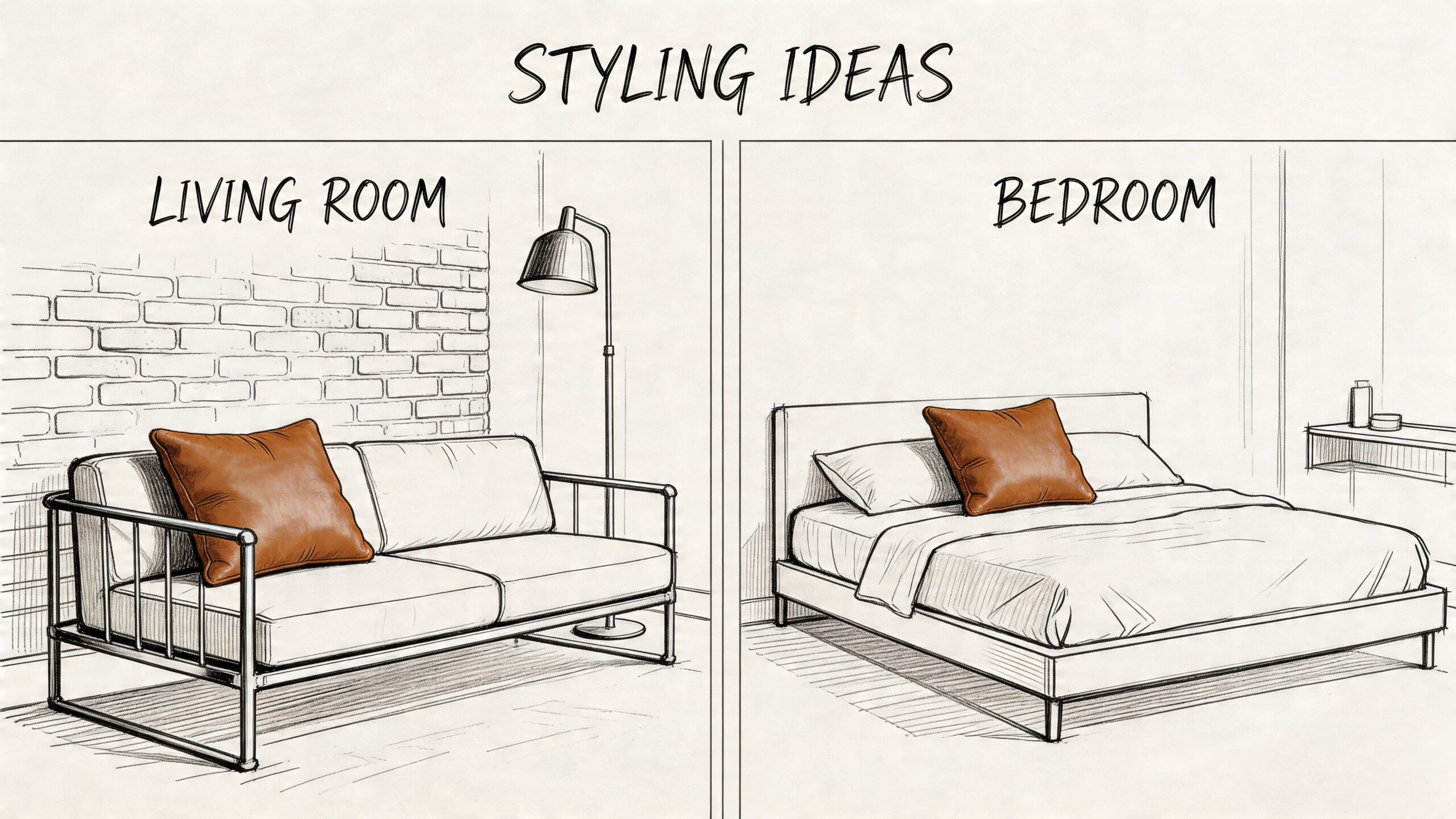
Faux leather decorative pillows work best when they’re treated as a contrast piece, not the whole story. Their job is to bring balance, shape, and a little polish.
If every pillow on the sofa is faux leather, the room can start to feel hard. If just one or two are layered with softer materials, the whole space feels more considered.
In the living room
A common mistake is matching everything too closely. If your sofa is beige, and your pillows are beige, and your throw is beige, the room may look calm but also unfinished.
A faux leather pillow helps break that up.
Try these combinations:
Gray sectional plus cognac pillow
This is one of the easiest pairings to get right. The gray stays cool and neutral. The cognac adds warmth.Cream sofa plus dark brown lumbar
This combination feels grounded and relaxed. Add a woven throw so the room still feels inviting.Charcoal recliner plus camel accent pillow
The lighter leather-look tone softens the darker seat and keeps the corner from feeling too heavy.
For a layered room, mix faux leather with at least one softer texture:
- Linen for an airy, relaxed look
- Velvet for a richer, dressier contrast
- Chunky knit for warmth in cooler months
- Boucle or nubby woven fabric for tactile variety
A lot of homeowners hesitate here because they think materials need to match. They don’t. They need to relate. If you want a helpful visual approach to that balance, this article on mixing leather furniture with fabric furniture shows why contrast often makes a room feel more complete.
In the bedroom
Bedrooms benefit from faux leather in a slightly different way. On a bed, it acts less like a durability choice and more like a finishing touch.
A single lumbar in faux leather can keep a bed from looking overly fluffy. That matters in rooms with upholstered headboards, quilts, and layered neutral bedding.
A few reliable setups:
Neutral bed with one cognac lumbar
White, ivory, oatmeal, and sand bedding can all use a little definition. A warm faux leather lumbar adds it quickly.Dark bed with black faux leather accent
This feels polished and clean, especially with crisp bedding and simple nightstands.Wood bed with saddle-tone pillow
The pillow echoes the warmth of the wood without introducing another busy pattern.
The strongest pillow arrangements usually mix shape as well as texture. A square, a lumbar, and one softer fabric often feel better than three matching squares.
How many pillows is enough
You usually need fewer faux leather pillows than fabric ones because they carry more visual weight.
A practical rule for seating:
Sofa
One or two faux leather pillows mixed with fabricSectional
One faux leather lumbar or a pair of balanced squaresAccent chair or recliner
Often one is enough
For beds:
Queen bed
One lumbar or one smaller accent pillow can be plentyKing bed
A longer lumbar or a pair with another soft layer often looks more proportional
Color choices that stay useful
If you want longevity, stay with tones that work like neutrals:
- Cognac
- Camel
- Chocolate
- Black
- Warm taupe
These shades usually move easily from one room to another if you refresh the space later.
Trend colors can still work, but faux leather already has a strong personality. In most homes, shape and texture make the statement more effectively than a loud color.
Proper Care to Keep Your Pillows Looking New
Many shoppers hear “easy clean” and assume faux leather needs almost no care. That’s where trouble starts.
Faux leather is often simple to maintain, but it isn’t indestructible. Harsh cleaners can do damage that doesn’t show up immediately. A pillow may still look fine the first few times, then begin to dry out, lose texture, or show surface wear.
Why homeowners get tripped up
A major problem is the lack of clear care guidance. Faux leather is often marketed as easy clean, but its polyurethane coating can degrade with harsh cleaners. At the same time, 68% of U.S. families with pets prioritize easy-clean fabrics, which helps explain why so many people want better care instructions, according to Statista’s home textiles topic page.
That gap leads to a familiar cycle. Someone buys a practical-looking pillow, treats a stain aggressively, and ends up damaging the finish more than the spill ever would have.
Everyday care that works
Routine care is usually simple.
Dust or shake off loose debris
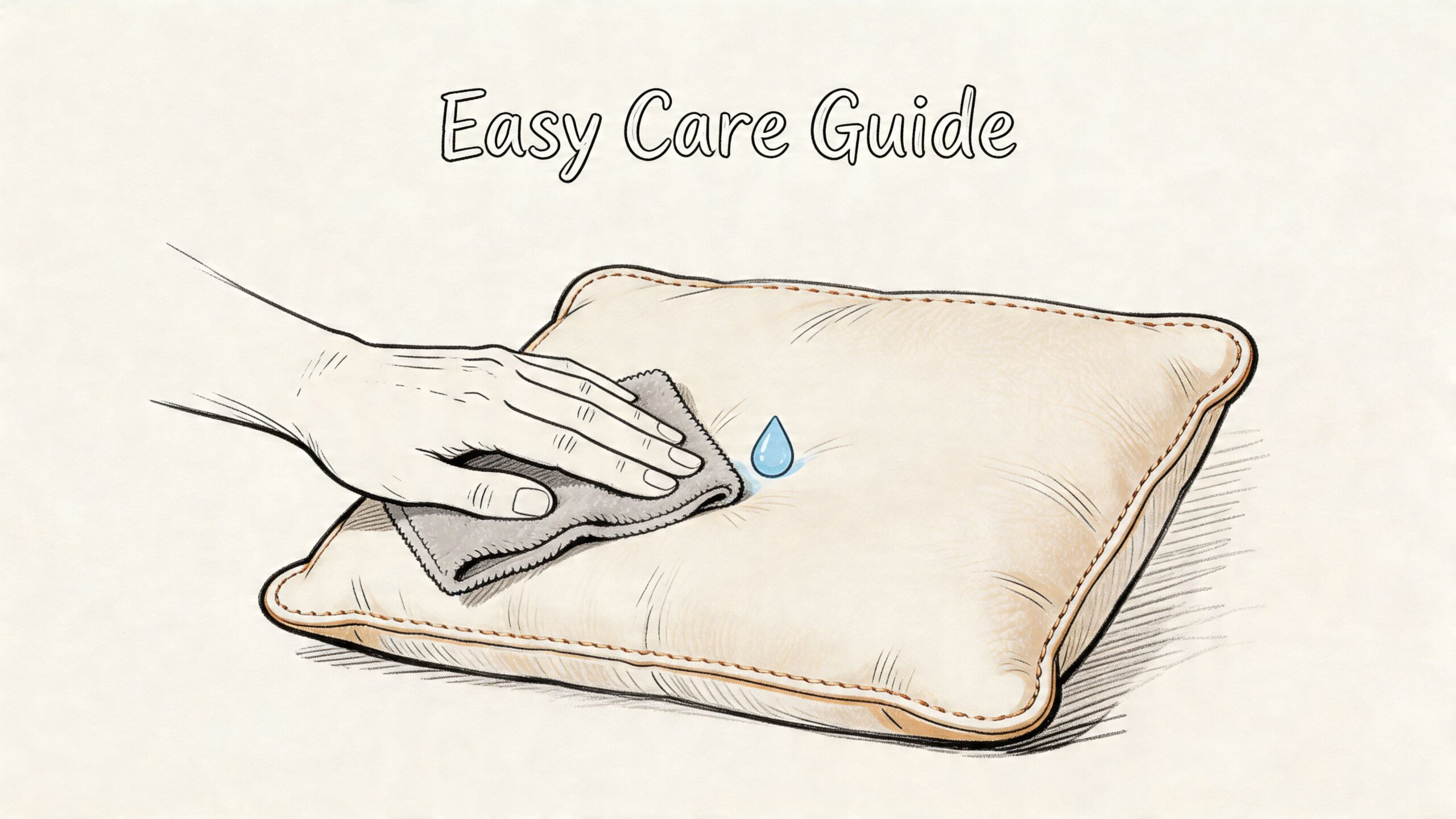
Pet hair, crumbs, and grit can sit on the surface.Use a soft, slightly damp cloth
Wipe gently instead of scrubbing.Dry with a clean cloth
Don’t leave lingering moisture sitting on seams.Let it air-dry naturally
Skip direct heat.
The goal is to clean the surface without stressing the coating.
What to do with a fresh spill
A quick response helps.
Blot first if there’s liquid. Then wipe the area gently with a damp cloth. Don’t soak the pillow, and don’t saturate the seams or zipper area. If the cover is removable, follow its care instructions rather than assuming every faux leather cover behaves the same way.
Gentle cleaning done right away usually beats deep cleaning done too late.
What to avoid
Some of the most common mistakes are also the most preventable.
Harsh chemical cleaners
These can strip or weaken the finish.Abrasive scrubbers
Rough pads can scratch the surface texture.Heat tools
High heat can affect the material’s finish.Full immersion in water
Faux leather pillows are usually better suited to spot cleaning.
Long-term habits that help
If the pillow lives in a sunny window seat or near a heat source, rotate it occasionally. If it’s on the family’s favorite recliner, fluff and reposition it so one corner doesn’t take all the wear.
Small maintenance habits make a visible difference with accent pieces. Decorative pillows don’t have to be high-maintenance, but they do reward sensible care.
Smart Choices for Your Budget and the Planet
Faux leather usually enters the conversation through style or price, but many homeowners also want to know whether it’s a responsible material choice. That’s a fair question, and the answer isn’t as simple as a label.
Some faux leather products are marketed as vegan or cruelty-free. That can matter to shoppers who want an alternative to genuine leather. But vegan doesn’t automatically mean uncomplicated from a sustainability standpoint.
Budget value isn’t just the price tag
Faux leather often costs less than genuine leather, which is one reason it works well for accent pillows. You can get the visual richness of a leather look without committing to leather-level pricing across every accessory in the room.
That said, the smartest budget choice usually isn’t the cheapest pillow on the shelf. A better-made pillow that keeps its shape, finish, and zipper function can be a stronger long-term buy than a bargain option that needs replacing quickly.
A sensible budget approach looks like this:
- Choose one strong faux leather accent instead of several weaker fillers
- Prioritize neutral tones that can move to another room later
- Look for removable inserts or covers when possible
- Buy for the furniture you have, not a staged photo online
The sustainability conversation needs honesty
The sustainability side of faux leather is more nuanced than marketing sometimes suggests. Many faux leathers are still petroleum-based. A 2025-2026 Nielsen survey shows 74% of U.S. homeowners seek cruelty-free verification, but few brands clearly disclose whether a product uses PVC or PU or explain recyclability, as noted on Eastern Accents’ faux leather pillow page.
That lack of material transparency is where shoppers often feel frustrated.
If you care about the environmental side, ask direct questions:
- Is the material PVC, PU, or another blend?
- Is the cover meant for long-term use or short-term trend appeal?
- Does the brand explain care and longevity clearly?
- Will this piece still work if the room evolves?
A practical definition of a smart purchase
For many homes, a smart purchase sits at the intersection of three things:
- Looks you’ll keep
- Construction that holds up
- Care requirements you’ll follow
That applies to faux leather decorative pillows as much as it does to sofas or dining chairs. A pillow that serves your room for years is usually a more thoughtful choice than one bought on impulse because it looked trendy for a moment.
Material labels matter, but so does lifespan. A piece you keep and use well is often a wiser purchase than one you replace repeatedly.
If you want to shop carefully, don’t just ask whether a pillow is vegan. Ask what it’s made of, how it’s built, and whether the seller gives you enough information to care for it properly.
Create a Home You Love with Watts Furniture
Faux leather decorative pillows earn their place because they solve a real decorating problem. They add polish without asking for a full room overhaul. They bring texture without visual clutter. And in many homes, they’re easier to live with than people expect, as long as you choose well and care for them properly.
That’s also why expert guidance matters. The right pillow isn’t just about color. It’s about scale, texture, construction, and how it works with the furniture you already own. Good design feels easy when the choices are thoughtful.
If you want to avoid the guesswork of mass-market shopping, local help makes a difference. Through the Interior Design Center, homeowners can get Complimentary In-Store Design Assistance for fabrics and color selections, or choose a Premium Design Service with space planning and mood boards, with the deposit credited back toward the furniture purchase.
That kind of support helps you build rooms that feel personal, not pulled from a catalog. It also pairs naturally with custom furniture, American-made furniture, and the kind of hometown service that makes buying feel less stressful and more confident.
For shoppers looking for a trusted furniture store LaGrange GA families return to, or comparing everything from living room sectionals to Mattresses LaGrange GA buyers can try in person, quality and guidance still matter. Furniture built for generations, not just a few seasons, gives every accent around it a stronger foundation.
Visit Watts Furniture & Mattress at 212 Commerce Avenue in LaGrange to experience the comfort of La-Z-Boy, explore Bassett recliners, discover American-made furniture from brands like Kincaid and Bassett, and get the reassurance of white-glove delivery, local support, and flexible financing. Ready to transform your space? Book a consultation with the Interior Design Center today and let the trusted local team help you curate a home you’ll love.