Find Your Perfect Mattress with Our Guides

Recliners with Power Headrest: Find Your Perfect Comfort


You know the feeling. You lean back after dinner, settle into the recliner, and then the small adjustments begin. One pillow behind the shoulders. Another tucked near the neck. A shift forward so you can see the TV. Ten minutes later, your chair is technically reclined, but your body still isn’t relaxed.
That’s usually the moment people start asking about recliners with power headrest.
The appeal isn’t just that they feel newer. It’s that they solve a very old comfort problem in a simple way. Instead of forcing your head and neck to adapt to the chair, the chair adapts to you. For families upgrading a living room in LaGrange, West Point, Pine Mountain, or anywhere around Troup County, that often becomes the difference between a chair that looks good in the room and a chair you use every day.
The End of Awkward Pillows and Stiff Necks
A traditional recliner can still be a comfortable seat. But it often asks you to choose between two imperfect options.
You can sit more upright so your head stays supported, which works for conversation but not always for full relaxation. Or you can recline farther back, which feels good on your legs and back, but leaves your head tilted in a way that makes reading or watching TV awkward.
That’s why so many people start improvising with pillows. They fold a throw behind the neck. They wedge a cushion at the shoulders. They keep adjusting because nothing stays where it should.
Why the old workaround falls short
Pillows can help for a few minutes. They rarely help for a full evening.
They slide down. They bunch up. They support one position but not the next. If you move from reading to watching a movie to closing your eyes for a short rest, you start the whole process over again. If that sounds familiar, the issue may not be your pillow setup. It may be that your chair can’t support your head independently from the recline.
For some households, the answer starts with softer accessories. If you’re still sorting out comfort basics, this guide to choosing the perfect pillow is a useful place to start. But when the problem is the angle of your neck, a pillow alone often can’t fix it.
A good recliner should let your body settle down, not give you another thing to adjust.
Why power headrests have become so popular
This is one reason modern power recliners have grown so quickly. The global recliner chair market was valued at approximately $3.5 billion in 2022 and is projected to reach $5.8 billion by 2030, with a 6.5% CAGR, largely fueled by power models with advanced features like independent headrest adjustment, according to Chita Living’s market summary on headrest recliners.
That growth makes sense when you try one in person. A power headrest recliner lets you lean back and still bring your line of sight forward. Your shoulders can stay relaxed while your head remains in a better viewing position. That small change feels surprisingly significant.
For people who read in the chair, stream shows, use a tablet, or want to rest without waking up with a stiff neck, it doesn’t feel like a gadget. It feels like common sense.
How a Power Headrest Recliner Works
You settle into the chair, press the recline button, and your back finally relaxes. Then your chin points at the ceiling. That mismatch is exactly what a power headrest is built to fix.
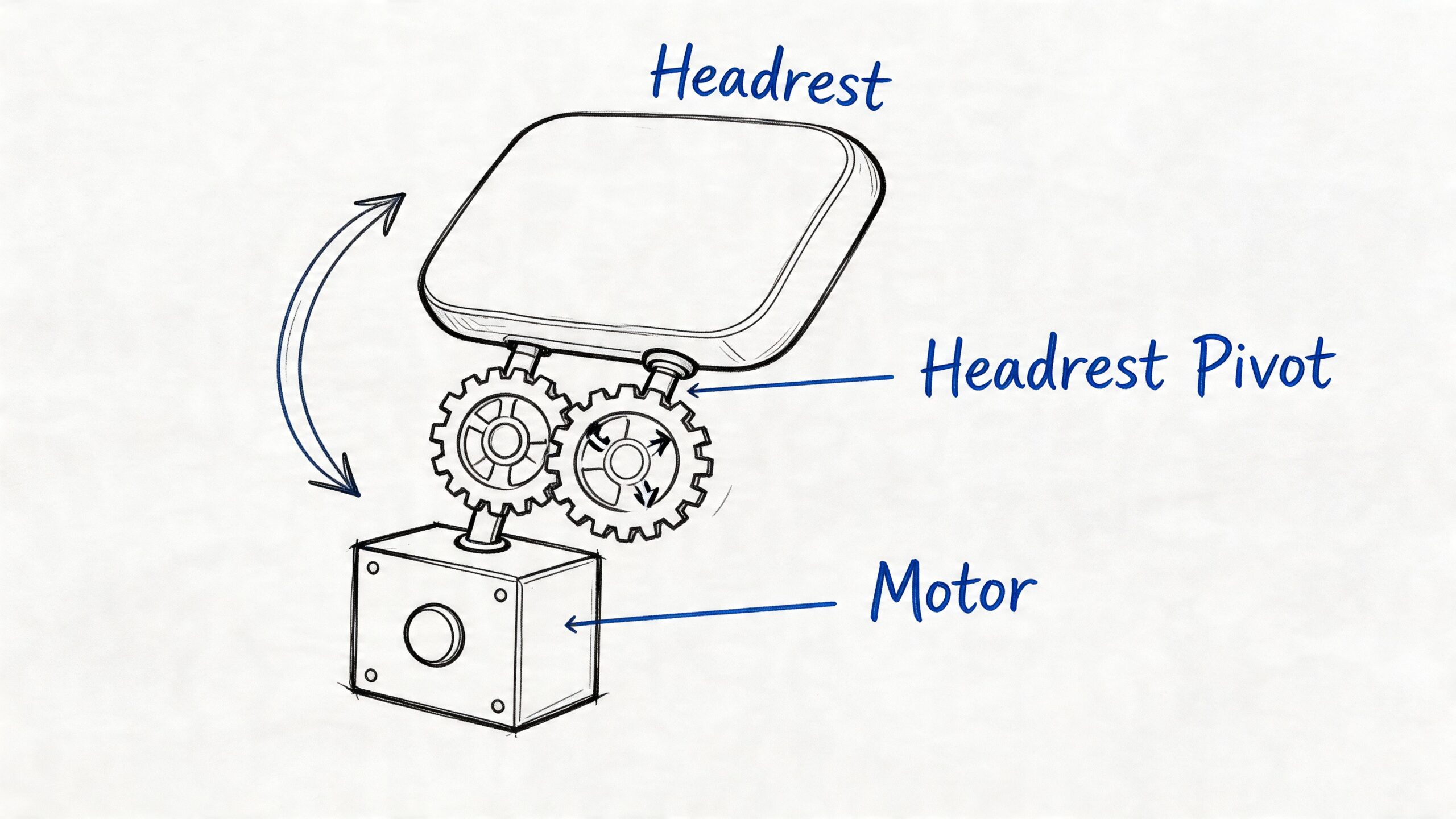
A standard recliner moves your body as one unit. A power headrest recliner adds a second adjustment at the top of the chair, so your upper back can stay comfortably reclined while your head and eyes stay in a natural position. It works a lot like a car seat with separate controls for the seatback and head support. One setting handles the larger posture. The other fine-tunes the part that often causes neck tension.
The separate motor is the key
Inside the chair, the headrest has its own motor, separate from the one that controls the main recline. That independence is the whole point.
Your body rarely wants one single angle from shoulders to head. In real life, your lower body may want to lean back while your neck needs a little more lift. Without that second adjustment, you often compensate by propping up a pillow, tucking your chin, or inching yourself into an awkward position after a few minutes.
A power headrest lets the chair do that fine-tuning for you.
What the controls feel like in everyday use
The process is simpler than it sounds:
- Set the recline where your back, hips, and legs feel relaxed.
- Adjust the headrest until your face is angled comfortably for what you are doing.
- Refine it a little if you switch from reading to watching TV, or from watching TV to resting.
That small second step changes the experience more than shoppers expect. Instead of forcing your neck to adapt to the chair, the chair adapts to you.
For families comparing layouts and motion options, this guide to types of power reclining seating gives a helpful overview of how these features show up across different pieces.
Why this supports better alignment
Head position affects strain more than people realize. If your head falls too far back, you tend to crane forward to see the television. If it sits too far forward, the muscles at the base of your neck keep working when they should be resting.
That is why this feature has staying power. It is not about adding another button for the sake of technology. It is about helping the chair fit the way people live, whether that means reading for half an hour, settling in for a movie, or taking pressure off the body when unwinding.
At Watts, we often explain it this way in the showroom. A good recliner should support you in layers. The seat supports your weight. The back supports your spine. The headrest finishes the job by supporting your line of sight and easing the load on your neck. Brands such as La-Z-Boy have refined that kind of adjustment so the chair feels personal, not mechanical, which makes a real difference over years of daily use.
Practical rule: If your body feels relaxed in a reclined position but your neck still feels busy, the chair may need better head support or a more precise fit.
That is also why trying one in person matters. The right power headrest recliner is not just a chair with extra motion. It is a long-term comfort tool, and good guidance helps you find the version that fits your height, habits, and home without the guesswork of an online gamble.
The Everyday Benefits of Perfect Support
Value shows up in ordinary moments. Not showroom moments. Home moments.
A good power headrest recliner lets one person watch the evening news, another read a novel, and someone else take a quick nap without fighting the chair each time. That flexibility is why these chairs become the seat everyone in the room claims first.
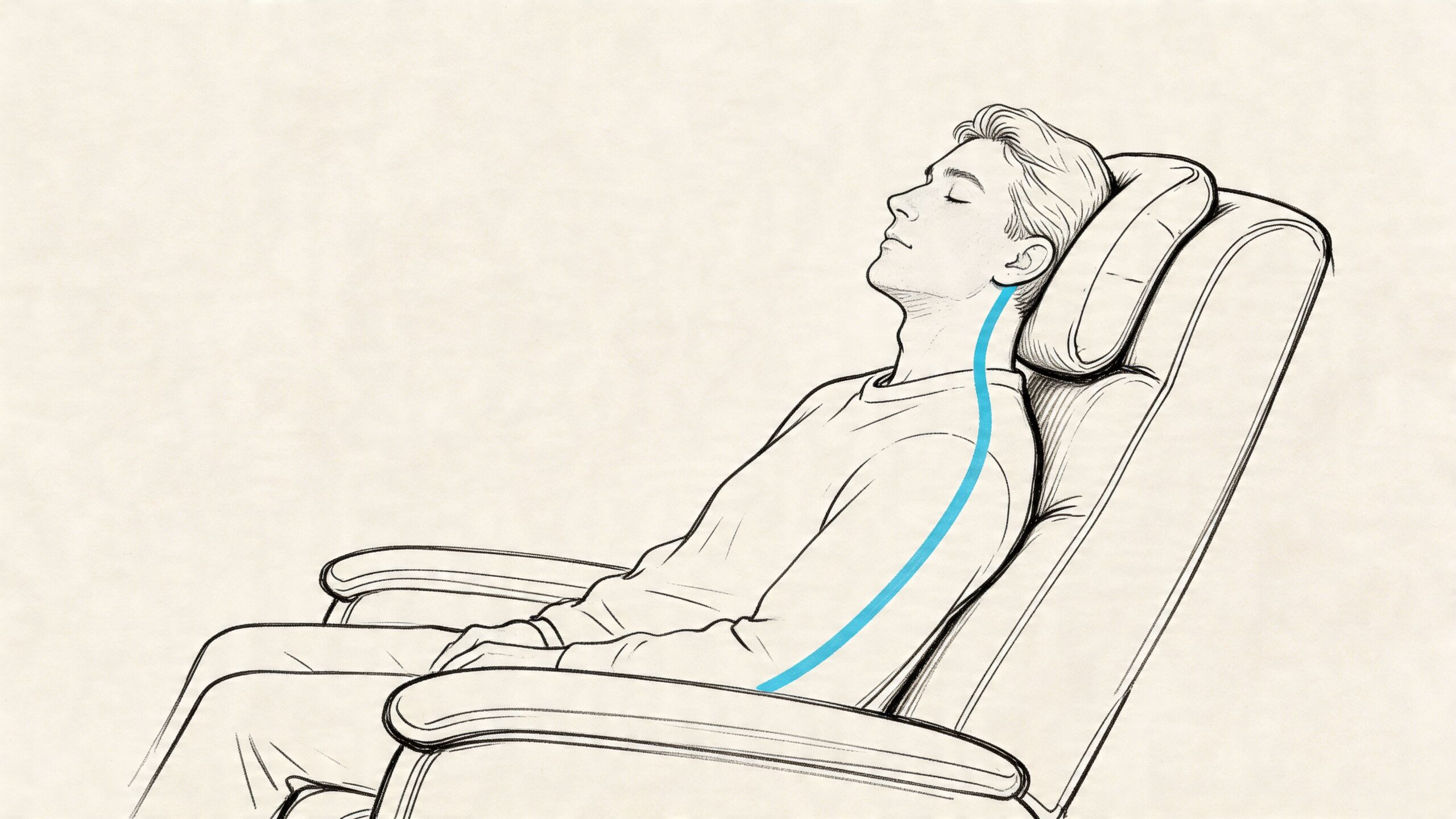
One chair, several uses
Fixed comfort works for only one posture. Adjustable comfort works with your day.
Here’s how that tends to play out:
- For reading: You can stay reclined enough to relax your back while keeping your head angled forward toward the page.
- For TV viewing: You don’t have to choose between leg support and a clear sightline.
- For resting: You can soften the angle and let your neck stay supported instead of dropping to one side.
- For shared family use: Taller and shorter users can fine-tune the top portion of the chair without stuffing blankets behind their shoulders.
This is one reason people often describe the chair as feeling more personal, even when multiple family members use it.
Support matters even more as needs change
Comfort and accessibility often overlap. For aging-in-place homeowners, power models can provide important support. The CDC reports that 30% of U.S. adults age 65 and older need assistive furniture, and nuanced positioning from a power headrest can help lower sleep apnea episodes by up to 25% according to recent NIH trials, as summarized in this overview of zero-gravity leather power recliners.
That doesn’t mean every buyer needs a medical-style chair. It means adjustability has practical value in everyday life.
Someone with arthritis may appreciate not having to wrestle with a manual mechanism. Someone recovering from a procedure may benefit from easier positioning. Someone who spends long evenings in the family room may notice less neck fatigue by the end of the night.
Why long-term comfort matters
In this context, quality construction matters too. A recliner that supports you well for years is different from one that feels impressive for five minutes on a sales floor. The goal should be furniture built for generations, not just a few seasons.
If you’re shopping with a parent or planning for your own future comfort, this roundup of best power recliners for seniors can help you think through mobility, support, and ease of use in a practical way.
Good support isn’t only about softness. It’s about whether the chair keeps your body comfortable after an hour, not just the first sit.
That’s why power headrests aren’t a novelty feature. They answer a daily need. They help a recliner fit more than one activity, more than one person, and more than one stage of life.
A Buyer's Guide to Power Recliner Features
A recliner can look impressive on a product page and still miss the mark in daily life. That usually happens when the feature list sounds good, but the chair does not match the way you sit, read, watch TV, or rest. A buyer’s guide should help you sort out what changes comfort over time, not just what sounds advanced.
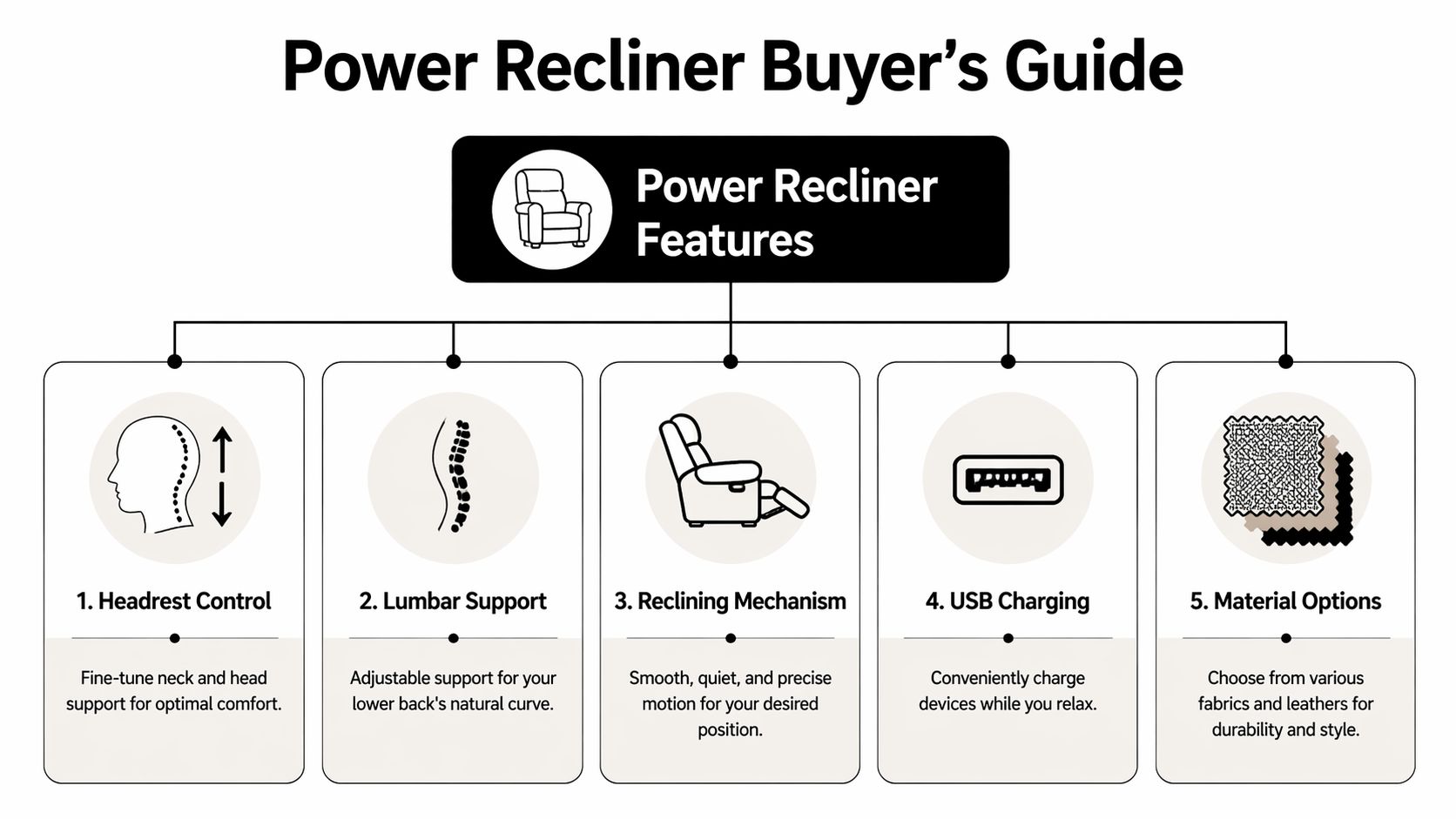
Start with how many adjustments the chair gives you
The first thing to check is the motion system.
Some power recliners only move the footrest and back together. Others give you separate control over the recline, headrest, and lumbar area. That difference matters because comfort is rarely one fixed position. A chair that lets you fine-tune each zone works more like a well-fitted pair of shoes than a one-size-fits-all option.
A dependable power system should feel:
- Smooth in motion: Position changes should feel controlled, not abrupt.
- Quiet during adjustment: Low noise matters in a living room or shared space.
- Easy to stop where you want: Small changes should be possible without overshooting the right spot.
Understand what the power headrest changes
Headrest adjustment sounds minor until you use it at home.
A small change at the top of the chair can shift your line of sight, support your neck, and help your shoulders relax. It is similar to adjusting the angle of a car seat headrest. The movement is not dramatic, but the effect on comfort can be immediate. If you watch a television mounted a bit high, read with glasses, or like to recline without feeling your head tip too far back, this feature earns its keep quickly.
Some manufacturers describe the movement range in inches, while others note that the headrest pivots upward for better viewing and neck support. Either way, the practical question is simple. Can you keep your head supported while looking where you want to look?
Power lumbar deserves equal attention
Many shoppers focus on the headrest first, then realize the lower back support is what determines whether the chair still feels good after an hour.
Independent lumbar adjustment fills the gap between the chair and your lower back. If that area is unsupported, your body tends to slump to find stability. Over time, that can make a recliner feel soft at first and tiring later. Brands such as Southern Motion describe power lumbar as a way to customize support in the lower back area, which is why it is often paired with power headrest in higher-end models on pages like the Southern Motion power headrest and lumbar recliner collection.
Here is the simplest way to compare the main comfort features:
| Feature | What it changes | Why it matters |
|---|---|---|
| Power headrest | Neck angle and viewing position | Helps you recline while keeping your head supported |
| Power lumbar | Lower back fill and support | Helps reduce slouching and that hollow feeling behind the lower back |
| Synchronized seat and back | How the chair moves through positions | Helps the body stay supported as you shift from upright to reclined |
Pay close attention to the controls
Controls are easy to overlook in the showroom. They matter every single day after the chair comes home.
A well-designed control panel should feel obvious in your hand. If the buttons are confusing, too sensitive, or placed awkwardly, even a well-built recliner can become annoying to use. This is one of those details online listings rarely explain well, which is why families often appreciate trying several styles in person at Watts and talking through how the chair will be used.
Look for controls that match the person using the chair:
- Simple two-button layouts suit buyers who want straightforward operation.
- Multi-button controls allow finer adjustment for headrest, lumbar, and recline.
- Home-position reset helps when more than one person uses the chair.
- USB charging makes sense if the recliner is also your reading, streaming, or phone-charging spot.
If you want a broader checklist before visiting a showroom, this ultimate recliner buying guide gives a helpful framework for comparing chairs side by side.
Buy for your routine, not for the longest feature list
The best buying question is not, “What is the fanciest model?” It is, “What do I need this chair to do well, day after day?”
A movie watcher may care most about head position and sight lines. Someone who reads for an hour each evening may care more about arm comfort, upright support, and easy micro-adjustments. A buyer planning ahead for long-term use may place more value on lumbar support, reliable motors, and service after the sale.
That is where local guidance changes the experience. A family-owned store can help you compare scale, controls, cushion feel, and brand differences in a way a product grid cannot. With design help and premium brands such as La-Z-Boy, the goal is not to sell the chair with the most buttons. It is to help you choose a recliner that fits your body, your room, and the way you plan to live with it for years.
Finding Your Perfect Fit with Customization
A power headrest recliner can have all the right functions on paper and still feel wrong in daily life. The practical test is simpler. Does it support your body in the places you need it, fit the scale of your room, and look like it belongs there for years, not just for delivery day?
That is often the sticking point for shoppers. A chair may recline beautifully, yet the seat feels too deep for your height. The headrest may adjust, but it lands behind your neck instead of supporting it. A leather swatch may look rich on a screen and then feel too cool, too shiny, or too dark once it is sitting beside your sofa.
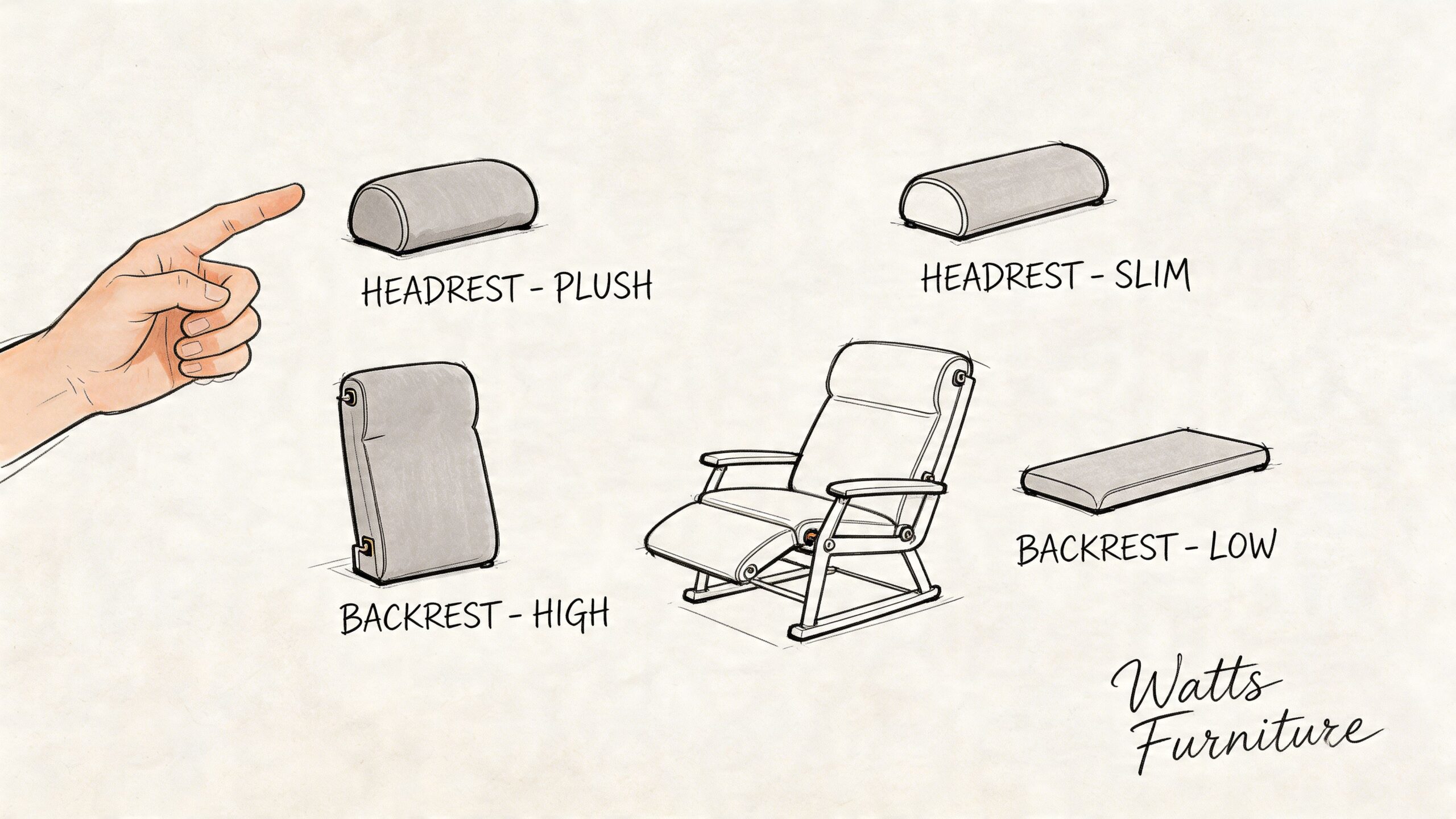
Fit is personal, not generic
Two people can sit in the same recliner and have completely different reactions. One feels supported. The other feels like they are always making small adjustments and never quite settling in.
Power headrest and lumbar features help fine-tune comfort, but they work best when the chair starts with the right proportions. Seat depth, back height, arm height, and overall scale still matter. A good comparison is buying shoes with adjustable laces. The laces help, but the shoe still needs to be the right size.
That is why premium models earn attention in the showroom. Chairs in the La-Z-Boy family, including Pinnacle styles mentioned earlier, offer more ways to tailor support. The value is not just having extra controls. The value is being able to shape the chair around your body and routine instead of adapting your posture to a one-size-fits-all seat.
What customization really changes
Customization changes how the recliner lives with you over time.
It affects how the chair wears in a sunny room, how forgiving the fabric is with pets, how easily the color works with your rug and flooring, and whether the overall silhouette feels relaxed or more structured. Those choices may sound decorative at first, but they have a practical effect on satisfaction a year from now.
A custom order usually helps you choose:
- Upholstery that fits real life: Leather, performance fabric, or another cover based on kids, pets, sunlight, and daily use.
- A scale that suits the room: A recliner should support you without crowding walkways or overpowering nearby furniture.
- The right comfort package: Power headrest alone for some households, or added lumbar and lift support for others.
- A look you will still like later: Color, texture, and shape that work with the room you already have.
For shoppers comparing options, this guide to getting started with a custom order explains how the process typically works.
Where design help makes a difference
The in-store experience becomes more useful at this stage.
Online filters can sort by width, color, and features, but they cannot tell you whether a chair feels supportive after twenty minutes, or whether the back scale looks too tall under your windows. In a showroom, you can sit long enough to notice pressure points, compare arm heights, and view fabric or leather samples in real light instead of studio photography.
At Watts Furniture & Mattress, shoppers can also use the Interior Design Center in two ways. Some want straightforward in-store help narrowing fabrics and colors. Others want a higher-touch design service with space planning and mood boards, with the deposit credited back toward the purchase. That guidance removes a lot of guesswork, especially for buyers trying to match an existing room instead of starting from scratch.
A well-chosen custom recliner should feel settled from the beginning. It should support your neck during a movie, look right next to the rest of your furniture, and keep making sense as your routine changes.
That is the long-term value of customization. You are not just choosing a chair with a power headrest. You are choosing how that chair will serve your body, your home, and your everyday comfort for years, with help from people who can stand behind the decision after the sale.
Making a Smart Investment in Lasting Comfort
A power headrest recliner usually costs more than a basic manual chair. That’s the honest starting point. The better question is what you’re paying for, and whether it will serve you well over time.
Most of the cost difference comes from a few areas: the quality of the motion system, the upholstery, the level of adjustability, and the brand’s approach to long-term support. A chair with power recline, a dedicated headrest motor, and power lumbar has more going on than a fixed-position recliner.
Why support after the sale matters
Power furniture has moving parts, which means even very good furniture can eventually need service.
A common consumer concern is maintenance of power mechanisms, and repair costs for a single motor can average $200 to $500, according to the consumer-focused summary provided in this Wayfair keyword research page. That’s exactly why warranty terms and authorized local service should be part of the buying decision, not an afterthought.
When people buy strictly by price online, they often compare fabric and dimensions but skip the support question. Then something minor goes wrong, and they discover how hard it is to get service, parts, or clear answers.
What adds long-term value
A smart purchase usually includes more than the chair itself.
Look for value in these areas:
- Authorized service access: It’s easier to get help when the retailer has a real support process in place.
- White-glove delivery and setup: Proper placement and setup reduce stress on both the customer and the product.
- Clear warranty guidance: You want to know what’s covered before you need it.
- Flexible payment options: 0% APR financing through Affirm can make a higher-quality purchase more manageable for some households.
For families in LaGrange, West Point, and across Troup County, hometown service often matters as much as the feature list. A local Service Request and Support Hub gives buyers a clearer path if they need assistance later. That’s part of buying a premium piece with confidence.
Think in years, not just price tags
The cheapest recliner and the best value aren’t always the same thing.
If a chair is used every evening for years, the equation changes. Comfort quality matters. Material durability matters. Service matters. The ability to repair rather than replace matters. That’s why a well-built power recliner can be a sensible investment in daily well-being, especially when it’s part of a room you use constantly.
Furniture should support your life for the long haul. That’s a very different standard from buying something that only needs to survive until the next trend cycle.
Common Questions About Power Headrest Recliners
Most shoppers are comfortable with the idea of power reclining once they try it. The remaining questions are usually practical ones. Here are the answers that tend to help most.
What happens if the power goes out
A power recliner needs electricity to operate its motorized functions. In a temporary outage, the chair won’t adjust until power is restored, unless the model includes a battery backup option.
That’s worth asking about before you buy, especially if the recliner is being purchased for someone with mobility concerns. For some households, backup capability brings peace of mind. For others, it’s less important than comfort, style, or room fit.
How much space do I need behind the recliner
The answer depends on the specific design.
Some recliners are built with wall-saver or space-conscious engineering, while others need more room to recline fully. This is one of the easiest places to make a mistake online because dimensions alone don’t always tell the whole story. The footprint changes as the chair moves.
A good in-store test is simple:
- Measure your wall space
- Note nearby tables or traffic paths
- Ask how the chair travels as it reclines
- Check whether the headrest motion changes where the chair sits visually in the room
For smaller homes and tighter living rooms, that conversation matters as much as fabric color.
Is a power recliner hard for seniors to use
Usually, no. In many cases, it’s easier to use than a manual recliner.
The controls are typically more intuitive than people expect. Pressing a button is often simpler than pushing back with the legs or using body weight to close the footrest. The key is choosing a control layout that isn’t cluttered and a chair size that fits the user properly.
If the chair is for a parent or grandparent, test these things in person:
- Can they reach the control without twisting?
- Can they stop the motion easily where they want it?
- Does the headrest support their line of sight naturally?
- Is the seat height comfortable for getting in and out?
Those details matter more than whether the chair has a long list of extra features.
Are recliners with power headrest worth it if I already have a decent recliner
If your current chair supports you well during the activities you do most, you may not need to replace it.
But if you often adjust pillows, shift your neck to see the TV, or feel tension after sitting a while, then yes, this feature can be worth it. The difference is less about luxury and more about whether the chair adapts to your body in the positions you use every day.
Try the chair the way you live in it. Lean back. Look toward where your television would be. Pretend you’re reading for half an hour. That’s when the value becomes obvious.
People in LaGrange, Pine Mountain, Hogansville, and nearby communities often find that one visit to a showroom clears up more confusion than hours of online comparison. Once you feel the difference between fixed support and adjustable support, the decision usually becomes much simpler.
Visit Watts Furniture & Mattress at 212 Commerce Avenue in LaGrange to experience the comfort of La-Z-Boy in person. If you’d like help narrowing down styles, fabrics, or room layout, book a consultation with the Interior Design Center for complimentary in-store guidance or a full planning service with space layouts and mood boards. It’s a practical way to avoid the guesswork of online shopping and choose furniture built for generations, not just a few seasons.