Find Your Perfect Mattress with Our Guides

Mastering Living Room Furniture Layout

You can feel when a living room isn't working. The sofa is too far from the chairs, the coffee table is in the way, the TV angle feels off, and everybody ends up sitting in the one spot that makes sense. That kind of room usually isn't missing better taste. It's missing a better plan.
A strong living room furniture layout solves daily problems before it worries about styling. It gives people a place to talk, a clear path to move through the room, and enough flexibility to handle movie night, guests, and the ordinary mess of real life. Good rooms don't happen by accident. They're arranged with purpose.
For homeowners in LaGrange, Troup County, West Point, Pine Mountain, and Hogansville, that matters even more. Many homes here need one living room to do several jobs well. If you're investing in custom furniture, living room sectionals, or American-made furniture, the layout has to support how you live, not just how a catalog photo looks.
The Foundation of a Flawless Layout
A living room usually goes off track before the furniture arrives. A homeowner tapes out a sofa with rough guesses, skips the swing of the door, forgets the floor vent, and then wonders why the room feels tight the day everything is delivered. I've seen that happen for decades, and it is far cheaper to solve on paper than after the truck leaves.
Measure the room before you shop
Start with the room itself. Record wall lengths, ceiling height, windows, doors, trim, outlets, vents, and any opening that affects placement. Then mark the paths people take. A layout that looks fine on a sketch can fail fast if someone has to squeeze past a chair every evening.
If you want a solid starting point, this guide on how to measure a room for furniture lays out the process clearly.
Good layout work is mostly about proportion. Some living rooms are compact and need tighter editing. Others have the square footage for larger seating groups, but still feel wrong if the furniture scale is off. The room does not need to match a label. It does need pieces that fit the space and leave enough breathing room to live in it comfortably.
That matters even more when you are buying better furniture meant to stay in the home for years. A well-built sofa or custom sectional gives you more options in fabric, depth, arm style, and configuration, but those choices only pay off if the size is right for the room.
Decide what the room must do well
Before choosing a sofa, decide what success looks like in daily life. Some families need a room that handles conversation in the evening. Others need clear sightlines for television, open floor space for grandchildren, or surfaces that can hold everything from coffee cups to homework.
I tell homeowners in LaGrange to settle on the top two jobs for the room. More than that, and the plan usually gets muddy.
- Start with daily habits. Set the room up for the way it is used on an ordinary Tuesday, not just when company comes over.
- Count the regular users. A couple, a young family, and homeowners who host church friends or neighbors every weekend will need different seating plans.
- Plan for the things that stay out. Throws, remotes, reading glasses, toys, and laptops need a home if you want the room to stay usable.
A pretty room that interrupts your routine is still a poor layout.
That is one reason online room sets disappoint so many homeowners. They are built to photograph well and ship fast, not to solve the quirks of your room or the way your family lives. Lasting rooms come from better planning, better fit, and furniture you can tailor to the space instead of forcing the space to accept whatever came in a box.
Professional layout help can save expensive trial and error, especially when you are investing in quality pieces you expect to keep. The goal is not to fill the room. The goal is to make it work well for a long time.
Identify and Honor Your Focal Point
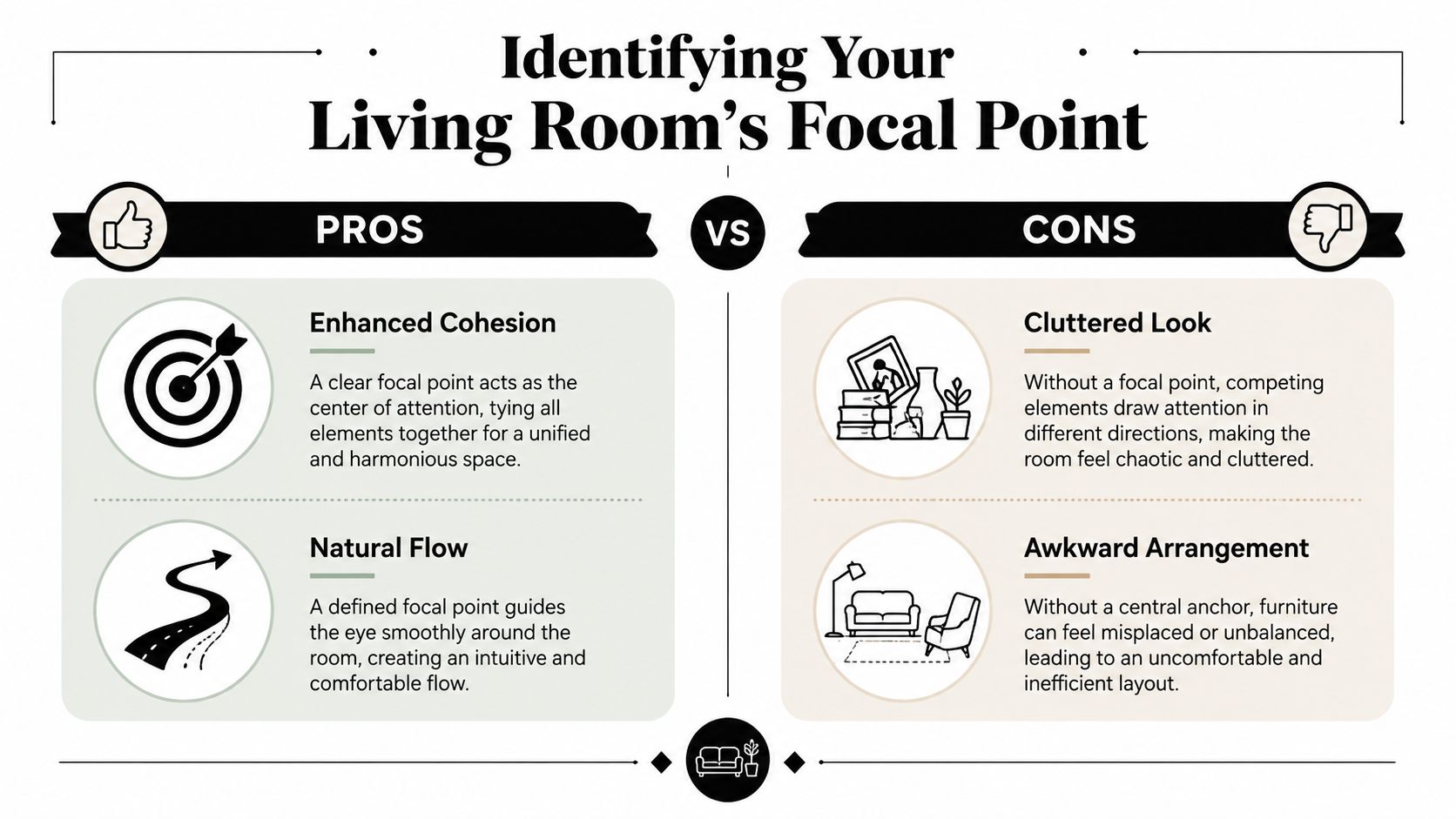
Every room needs an anchor. Without one, furniture placement gets scattered fast. Chairs face one direction, the sofa favors another, and the room starts feeling like several unrelated decisions pushed together.
Pick the feature that deserves the most attention
In some homes, the focal point is obvious. It's the fireplace, a large window, or the TV wall. In others, you have to choose it. The mistake is trying to make every feature the star.
A room works better when seating supports one primary focal point and any secondary feature plays a supporting role. If the fireplace is beautiful but the family watches television every night, be honest about that. A layout should serve real habits.
For media-focused spaces, this article on calculating the best placement for your sofa and television can help you think through sightlines before you commit to furniture placement.
Use spacing rules that make the room usable
Layout stops being guesswork when considering the guidelines. Snaidero America's guide highlights a few baseline standards designers commonly use: 16–20 inches between a sofa and coffee table, 32–40 inches for main walkways, and a TV viewing distance of 2–3 times the screen diagonal.
Those numbers work because they solve three common problems at once:
| Layout decision | What works | What usually goes wrong |
|---|---|---|
| Coffee table placement | Keep it close enough to reach comfortably | Too far away, so nobody uses it |
| Main path through room | Leave a clear passage that feels natural | People squeeze past corners and knees |
| TV seating distance | Match seating to screen size and room use | Screen feels too dominant or too distant |
A coffee table that sits too far from the sofa looks fine in photos and feels silly in real life. A walkway that's too tight makes the room feel smaller every time someone passes through it. A television that's placed without regard to viewing distance turns a relaxing room into a compromise.
A focal point should organize the room, not bully it.
Let furniture shape itself around the room
This is one place where Custom La-Z-Boy recliners or a sectional with configurable pieces can help. In a room with a corner fireplace, a long wall of windows, or an off-center media setup, a fixed matching set may force the wrong arrangement. A sectional that can be configured to the room often gives you a cleaner answer.
That's also why true customization that reflects your home, not a mass-produced catalog matters. The room's architecture should lead. The furniture should follow.
Create Purposeful Zones for Modern Living
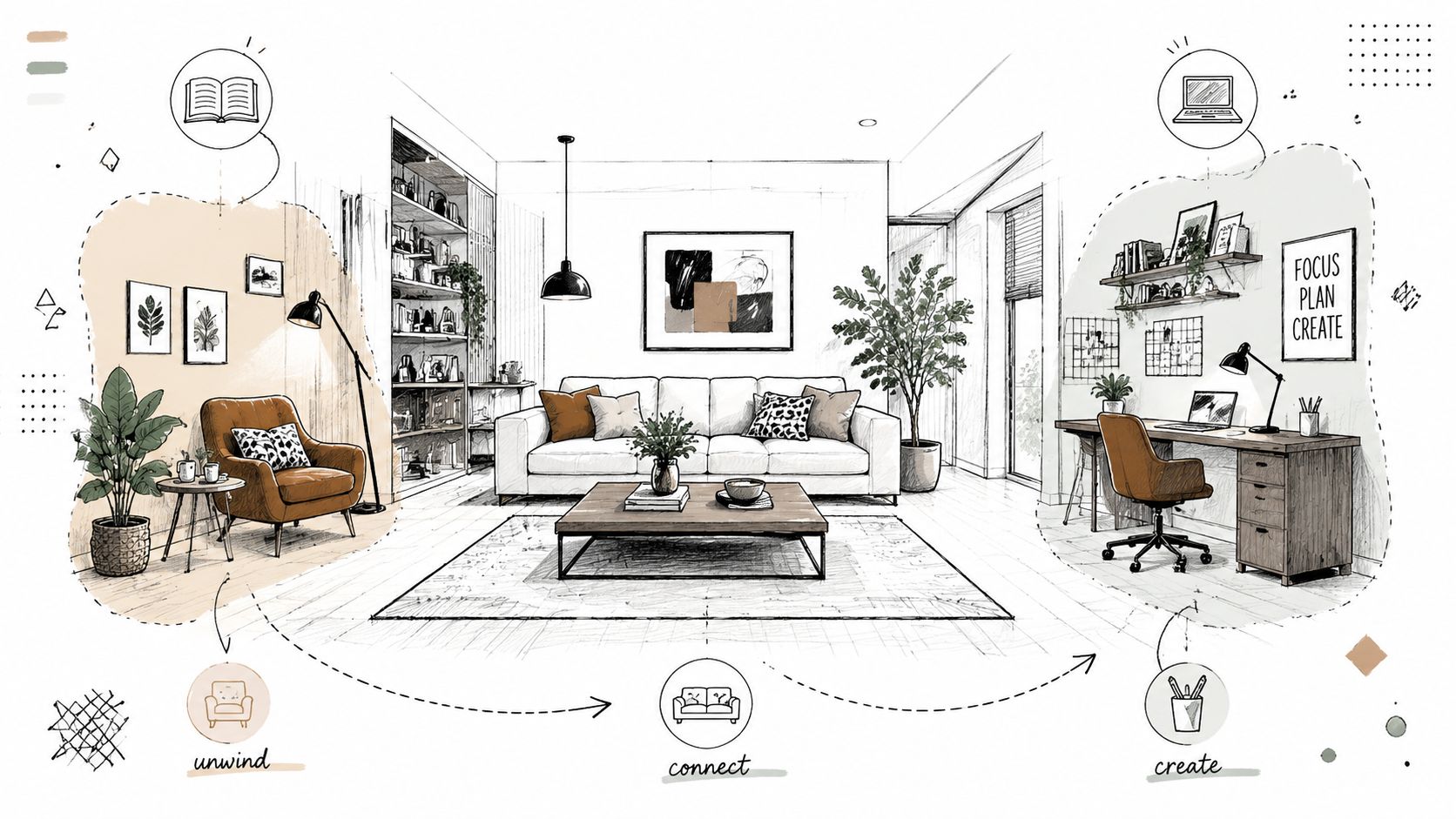
A lot of living rooms no longer serve one simple purpose. They're TV room, reading room, homework spot, casual office, and play area all at once. If you treat that kind of room like a formal conversation box, it falls apart quickly.
Think in zones, not matching sets
A well-zoned room feels calm because each area has a job. One part supports watching TV. Another allows conversation. A smaller edge space might handle laptop work or reading. The room still feels connected, but it stops asking one furniture arrangement to do everything.
That's why the old habit of buying a full matching suite can disappoint people. It may look complete on delivery day, but it often performs poorly once the household starts using it.
According to Boston 25's design trend coverage on flexible, multi-functional spaces, many homes need a living room to support TV watching, work, and kids' play, and layouts often work better when they use pieces like sectionals, swivel chairs, and storage ottomans instead of relying on a single fixed arrangement.
What zoning looks like in practice
Here are a few combinations that consistently work better than a rigid furniture set:
- Sectional plus swivel chair. The sectional handles primary seating, while the swivel chair can turn toward the TV, fireplace, or conversation area.
- Storage ottoman instead of a formal table. It softens the room and adds a place to hide daily clutter.
- Console behind the sofa. This can define a walkway in an open plan without building a visual wall.
- Compact desk or writing surface at the edge. Keeping work to one side helps the room stay livable after the laptop closes.
A room with zones usually feels more generous because it acknowledges real behavior. You stop fighting the room and start using it well.
Why customization matters more in open homes
Open-plan spaces are where layout shortcuts show up fastest. If your sofa back is visible from the kitchen, the proportions matter. If the room opens to a traffic path, chair placement matters. If one end of the room needs to stay flexible, the piece selection matters.
That's where personalized choices in fabric, scale, and configuration can solve problems generic pieces can't. Homeowners comparing options often find that Bassett recliners, custom sectionals, and other custom furniture choices give them more control over the way the room functions day to day.
For homeowners dealing with connected spaces, advice on how to decorate an open floor plan can help you think through boundaries without making the room feel boxed in.
Mastering Placement for Flow and Connection
Some rooms look large on paper and still feel cramped once furnished. The usual reason is poor circulation. Furniture may technically fit, but people can't move through the room naturally.
Stop pushing everything against the walls
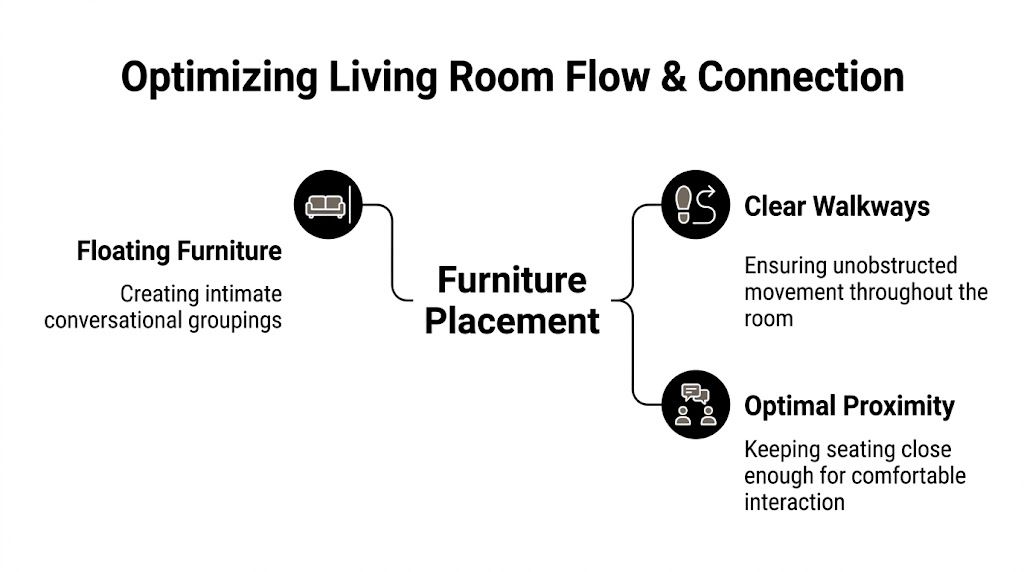
This is one of the most common layout mistakes. People assume that shoving the sofa to the perimeter will make the room feel bigger. In many living rooms, it does the opposite. It flattens the space, weakens conversation, and leaves an awkward empty middle that doesn't function.
Creative Bloq's guidance on common living room layout mistakes notes that designers recommend preserving a clear primary walking path of about 30–36 inches between major pieces when possible, and it points out that pushing all furniture to the walls can make conversation awkward and the room less functional. The same guidance also notes that a floating seating arrangement often improves flow and usability.
That's the secret many people miss. Furniture doesn't always belong on the edges. Sometimes it belongs where people use it.
Build the walkway first
A good room has a path that feels obvious. You should be able to enter, cross, and sit down without weaving around corners.
Try this order:
- Map the main path from the doorway to the most-used part of the room.
- Place the largest piece first, usually the sofa or sectional.
- Add chairs only after the walkway still feels clear.
- Check corners and table edges where traffic tends to pinch.
If the room is tight, clearance becomes even more important. The room doesn't need to feel formal. It needs to feel easy.
When people have to sidestep a chair every day, the layout is wrong even if the styling is right.
Bring seating closer together
A room can have good traffic flow and still feel disconnected. That happens when seating is spread too far apart. People end up raising their voices, leaning forward, or abandoning half the chairs in the room.
Conversation works best when seating feels intentionally grouped, not scattered around the perimeter. Floating a sofa over a rug, then bringing chairs inward, usually creates a more natural center of gravity.
One practical option for homeowners who don't want to figure out placement alone is design help paired with delivery and setup. Watts Furniture & Mattress offers layout support through its Interior Design Center, along with white-glove delivery that places and sets up furniture rather than leaving boxed pieces at the door. That kind of follow-through matters when a plan needs to become a functioning room on day one.
What works and what doesn't
| Approach | Works well when | Usually fails when |
|---|---|---|
| Floating sofa arrangement | You need conversation and better flow | The room is so packed that no walkway remains |
| Wall-hugging furniture | The room is extremely narrow or constrained | You're trying to make a social room feel connected |
| Accent chairs angled inward | You want flexibility and a softer grouping | Chairs become decorative only and never get used |
| Oversized sectional | The room's main function is lounging or TV | It blocks movement or dominates every sightline |
The best placement almost always feels calm. You're not noticing furniture obstacles. You're just using the room.
Layering Rugs Lighting and Tables to Complete the Look
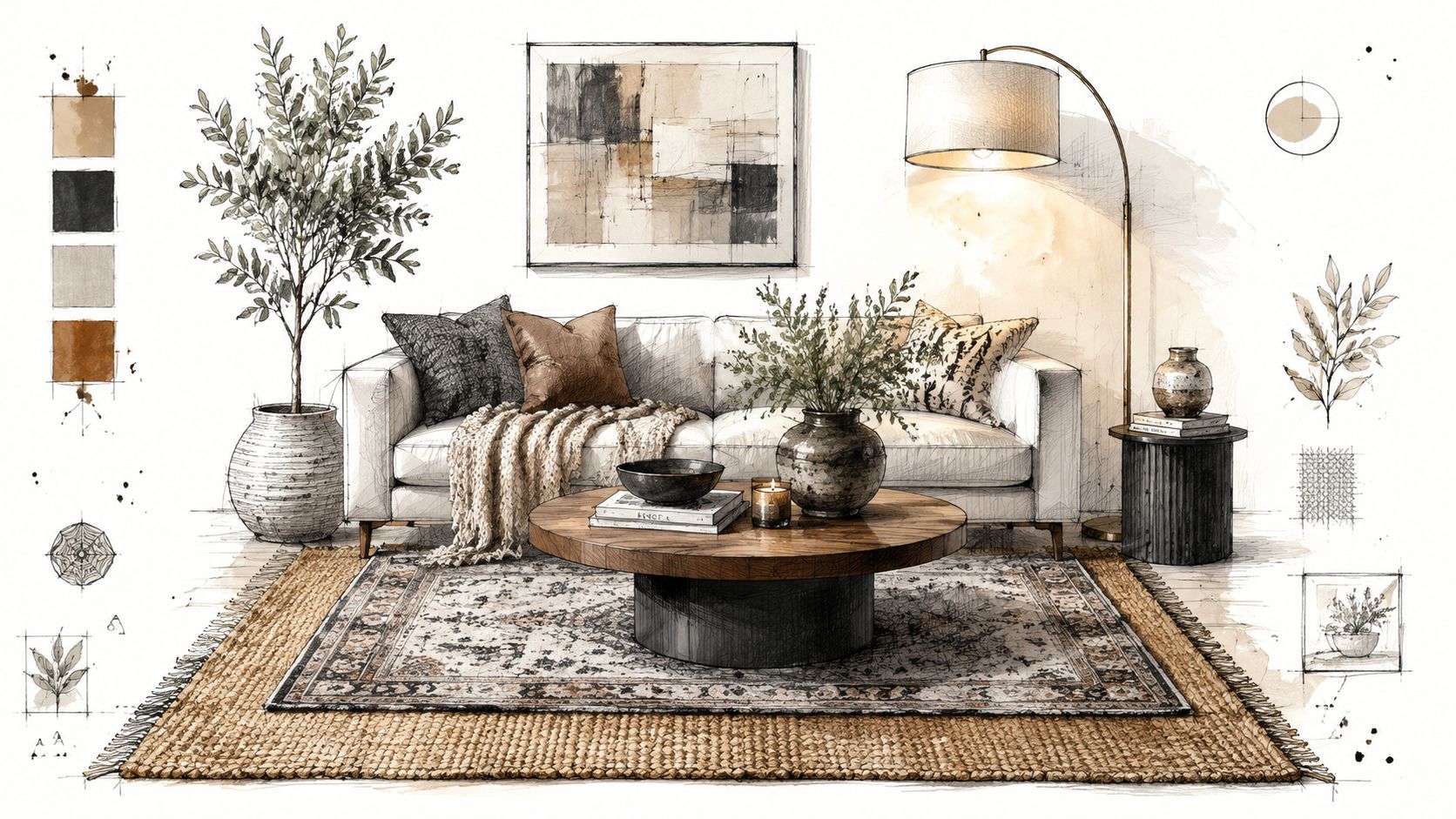
A room can have the right sofa, the right chairs, and still feel unfinished by supper time. In real homes around LaGrange, the missing piece is often the layer that makes the room comfortable to use every day. Rugs keep a seating group grounded. Lighting changes how the room feels at 8 a.m. and at 8 p.m. Tables keep remotes, coffee cups, books, and reading glasses within reach.
Rugs should anchor, not drift
A rug works best when it ties the whole seating area together. If it only floats under the coffee table, the room usually feels pieced together instead of settled.
Many homeowners miss the size by one step. They buy for the open floor they see, not for the furniture grouping they want to support. This guide on how to pick the right rug size helps you match the rug to the way the room is arranged.
A larger rug often costs more up front, but it usually saves the room. A too-small rug makes good furniture look temporary.
Lighting should match the way you live
One ceiling fixture rarely handles a living room well, especially in a house where the room has to do more than one job. Most spaces need a mix of light sources placed at different heights.
Use lighting with a purpose:
- Ambient lighting for general brightness
- Task lighting beside a reading chair or end table
- Accent lighting to soften dark corners and add depth at night
That mix matters in family rooms that shift through the day. Morning coffee, after-school homework, television, and evening reading all ask something different from the space. Good lighting lets the room change with you without adding clutter or glare.
Tables should earn their place
Coffee tables, end tables, and drink tables need to do more than fill gaps. They should land where a hand naturally reaches. If a guest has nowhere to set a glass or a lamp sits too far from the chair, the room starts to feel inconvenient no matter how nice it looks.
I usually tell homeowners to judge tables by use first, then by style. A beautiful table that is too low, too deep, or too far away will frustrate you every day. A well-placed table helps the room feel balanced and easy to live in.
This is also the stage where materials and finishes matter. Wood tones, metal finishes, lamp shapes, and fabric textures need to relate without looking like a matched set from a warehouse page. Watts Furniture & Mattress offers complimentary in-store design assistance for exactly that kind of decision making. It helps homeowners sort through good options and choose pieces that will still feel right years from now, not just for one season.
Avoid the Guesswork with Professional Design Guidance
You can absolutely improve a living room on your own. Many homeowners do. But the risk isn't usually bad taste. It's buying solid pieces in the wrong size, wrong configuration, or wrong relationship to the room.
That's why professional design help makes sense for more than high-style homes. It protects the investment. A thoughtful plan helps you avoid furniture that looks right online but performs poorly once it arrives. It also helps you create a room that can age well with your family instead of needing to be redone after a short stretch.
For homeowners who want expert input, working with an interior designer can be much simpler than people expect. At Watts, the Interior Design Center offers two levels of help. There's Complimentary In-Store Advice for fabrics, finishes, and color coordination, and there's a Premium Design Service for deeper planning such as space layouts and mood boards, with the deposit credited back toward the purchase.
That kind of guidance is especially valuable when you're choosing American-made furniture from names such as:
- Bassett
- Kincaid
- La-Z-Boy
These are the purchases where planning matters most. This is furniture built for generations, not just a few seasons. It deserves a layout that does it justice.
It also helps take the stress out of the process. You avoid the guesswork of online shopping with our expert Design Center, and you end up with a room that fits your life instead of a room that only looked good on a screen.
Ready to create a living room that feels comfortable, functional, and finished? Visit the Watts Furniture & Mattress showroom at 212 Commerce Avenue in LaGrange to experience the comfort of La-Z-Boy in person, explore custom furniture options, and get help from the Interior Design Center. If you want a full plan for your space, book a consultation and let the team help you curate a home you'll love.