Find Your Perfect Mattress with Our Guides

How to Decorate an Open Floor Plan: A LaGrange Guide

You walk into an open living, dining, and kitchen space and the first reaction is usually the same. It feels bright, spacious, and full of possibility.
The second reaction is less fun. Where does the sofa go, how do you keep the room from echoing, and how do you make one big space feel welcoming instead of exposed?
That tension is normal. A 2023 Rocket Mortgage survey summarized by NAR found homeowners are almost evenly split, with 51% favoring open layouts and 49% preferring traditional ones. The layout itself isn't the whole story. What matters is whether the room supports how your family lives, rests, works, and gathers.
Good open-plan decorating solves problems that walls used to solve automatically. It creates boundaries without closing the room in. It softens noise. It adds storage without adding clutter. And it gives each area a purpose while still letting the whole home feel connected.
Embracing the Possibilities of Your Open Space
An open floor plan asks more from your furniture than a traditional layout does. In a closed room, walls define the edges, direct traffic, and hide a little mess. In an open plan, your furniture, rugs, lighting, and finishes have to do that work.
That's why some open spaces feel calm and polished while others feel unsettled. The difference usually isn't the square footage. It's whether the room has been given structure.
What works in a real home
The best open spaces balance connection and control. You want sightlines and light, but you also want a place to read while someone else watches television, a dining area that feels intentional, and a living zone that doesn't drift into the kitchen.
A few goals matter most:
- Create visible zones so each area feels purposeful
- Protect traffic flow so people can move naturally
- Repeat key elements so the whole room feels related
- Choose durable pieces because open plans tend to be high-traffic spaces
Open concept rooms don't need more stuff. They need better-defined jobs for the pieces already in them.
That shift in thinking helps. Instead of asking how to fill a big room, ask how to support the moments that happen there. Morning coffee at the island. Homework at the dining table. Movie night. Guests stopping by. Kids cutting through the room on the way outside.
Where many homeowners get stuck
Most decorating mistakes in open floor plans happen for one of three reasons. The furniture is too small for the space, everything is pushed to the walls, or every zone is treated like a separate room with no visual connection.
Online shopping tends to make that worse. A sofa can look generous on a screen and undersized in a room with tall ceilings and a wide footprint. A rug can look large until it lands in the space and only covers the coffee table. That's where measured planning beats guesswork every time.
Creating Functional Zones for the Way You Live
An open floor plan works best when you define use before you choose furniture. Start with behavior, not products. If you skip that step, even beautiful pieces can end up floating without purpose.
According to a National Association of Home Builders survey cited here, 85% of homebuyers prioritize an open connection between the kitchen and dining area. That makes visual separation an important decorating skill, especially in homes where several activities happen at once.
Start with daily patterns
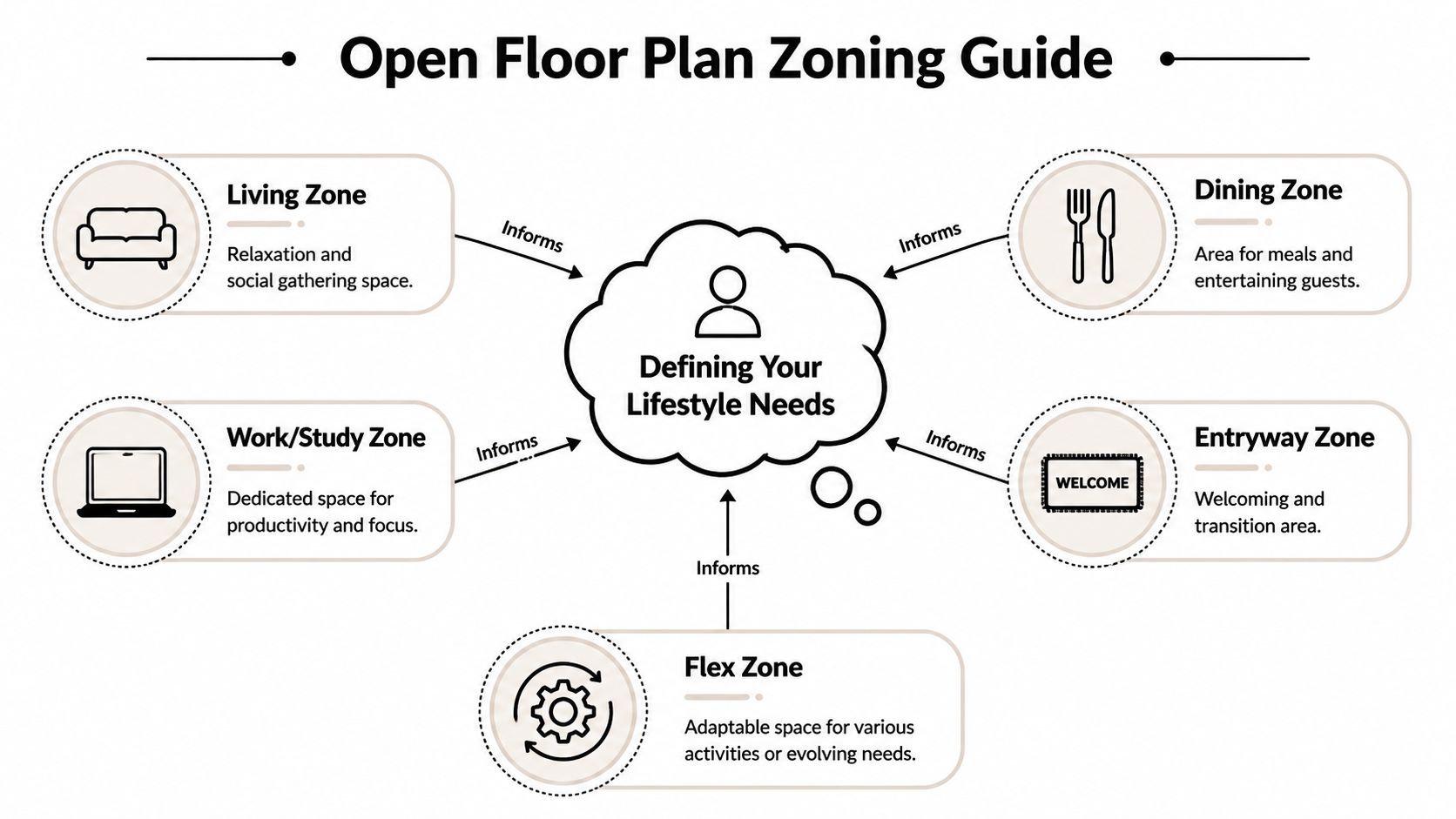
Walk the room and mark the activities that need a home. In most open layouts, that means some version of these zones:
- Living zone for conversation, television, or reading
- Dining zone for meals, homework, and overflow seating
- Work or study zone if someone needs focus during the day
- Entry zone if the room opens near the front or garage door
- Flex zone for toys, a bar cart, a game table, or a quiet chair
If you're not sure how those pieces should relate, a simple room sketch helps. Our guide on how to plan a room layout is useful for sorting out what belongs where before anything heavy gets moved.
Use rugs as the first layer of definition
In an open plan, rugs do more than soften the floor. They announce that a zone begins here and ends there.
A large rug under the living area tells the eye that the seating belongs together. A separate rug under the dining table gives the meal space its own identity. When rugs are too small, the room feels disconnected and temporary.
Use these practical guidelines:
- Living areas usually need a rug large enough for the main seating to sit on it comfortably
- Dining areas need a rug that allows chairs to stay on the rug when pulled out
- Pattern and color should relate across zones, not match exactly
Practical rule: If a rug looks like a postage stamp in the center of the room, it isn't defining a zone. It's just occupying floor.
Give every zone a reason to exist
A common mistake is creating a dining area nobody uses or leaving a dead corner because it doesn't fit a standard room label. Open plans reward honesty. If your family eats at the island and uses the table for projects, furnish the dining zone to handle both. If one corner gets the best natural light, make it a reading chair and lamp instead of forcing a bench there because a blog said you need one.
That kind of planning creates rooms that feel natural instead of staged.
Choosing the Right Furniture Scale and Layout
Once the zones are clear, furniture becomes your architecture. It shapes conversation, controls movement, and gives the room weight.
Designer surveys summarized by LK Design found that 85% of cohesive open plans are achieved through strategic furniture zoning, versus 40% of plans that lack this, and one of the key techniques is using large area rugs with an 8×10 ft minimum for living groupings. That matches what seasoned designers see every day. Scale and placement do more work in an open room than styling accessories ever will.
Stop lining everything against the walls
In a closed room, wall-hugging can work. In an open plan, it often makes the center feel empty and the perimeter feel crowded.
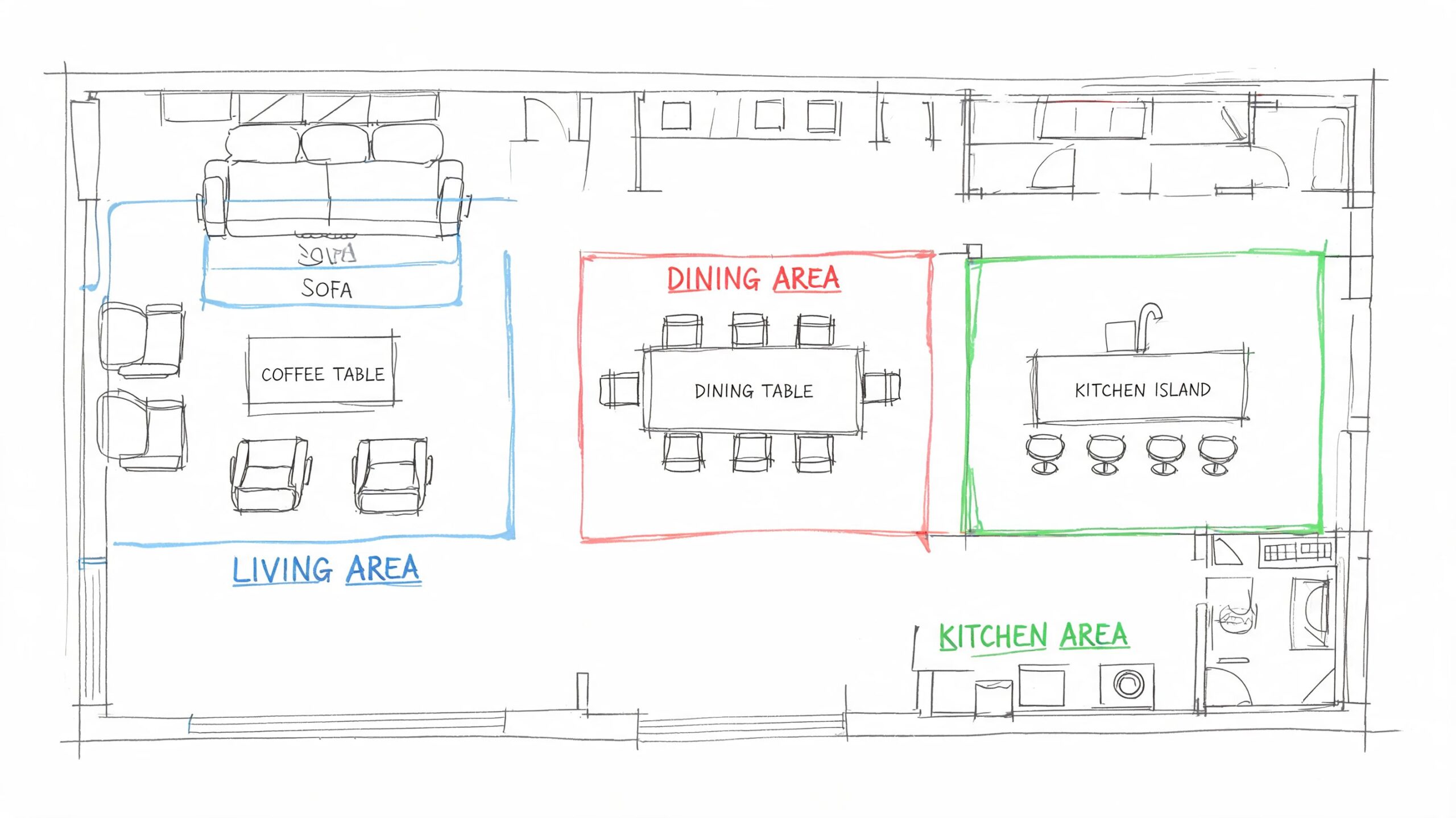
A better layout usually involves floating the main sofa or sectional so it helps divide the living area from the dining space or kitchen. The back of a sofa can act like a low wall, especially when paired with a console table. Chairs can turn inward to create a conversation area instead of facing every seat toward the television.
This approach does three things well:
- Defines the room without building barriers
- Improves intimacy in a large footprint
- Preserves sightlines across the house
Match the size of the furniture to the size of the zone
Small furniture disappears in a large open room. Oversized furniture can choke circulation. The goal is presence without blockage.
A quick planning check helps before you buy. Use a tape measure, mark dimensions on the floor, and compare them to your walkways. Our article on how to measure a room for furniture makes that process much easier, especially when you're deciding between a sofa, a sectional, or a pair of chairs.
Here are the pieces that usually anchor an open plan well:
| Area | Usually works well | Usually goes wrong |
|---|---|---|
| Living zone | Substantial sofa, sectional, or sofa with two chairs | Apartment-scale seating that looks undersized |
| Dining zone | Table centered under lighting with clear pull-back room | Table pushed against a wall in a large open room |
| Transition area | Console, credenza, or bench with purpose | Decorative filler that adds clutter |
Use grouping, not scattering
The room should read as a few strong arrangements, not many small disconnected ones.
A living area often feels right when the main upholstered pieces sit in a conversation pattern. That might be a sectional with one accent chair. It might be a sofa facing two swivels. It might be a sofa and loveseat only if the room can support that weight without narrowing the path through the space.
Furniture in an open plan should relate across the room, but it should converse within its own zone.
Where customization pays off
Open floor plans expose every compromise. If a sectional is too deep, you'll feel it every time you walk behind it. If it's too short, the room will always seem underfurnished. That's why special-order upholstery can make such a difference.
A custom La-Z-Boy sectional can be configured to suit a TV wall, fireplace, or awkward transition to the kitchen. A Bassett sofa with the right arm profile, depth, and fabric can hold its own in a wide room without overpowering it. That's true customization that reflects your home, not a mass-produced catalog.
For homeowners who want help sorting through those decisions, the Watts Furniture & Mattress showroom offers access to custom upholstery options along with an Interior Design Center that helps with layout and finish coordination.
Achieving Cohesion with Color Texture and Light
A well-zoned open plan still needs one more thing. It has to feel like one home, not three unrelated furniture displays.
That sense of unity usually comes from repetition. Data from over 500 projects summarized by Polished Habitat shows that 92% of open plans using a repetitive color palette and material scheme report a cohesive feel, and a core technique is using rugs that overlap furniture edges by 12 to 18 inches.
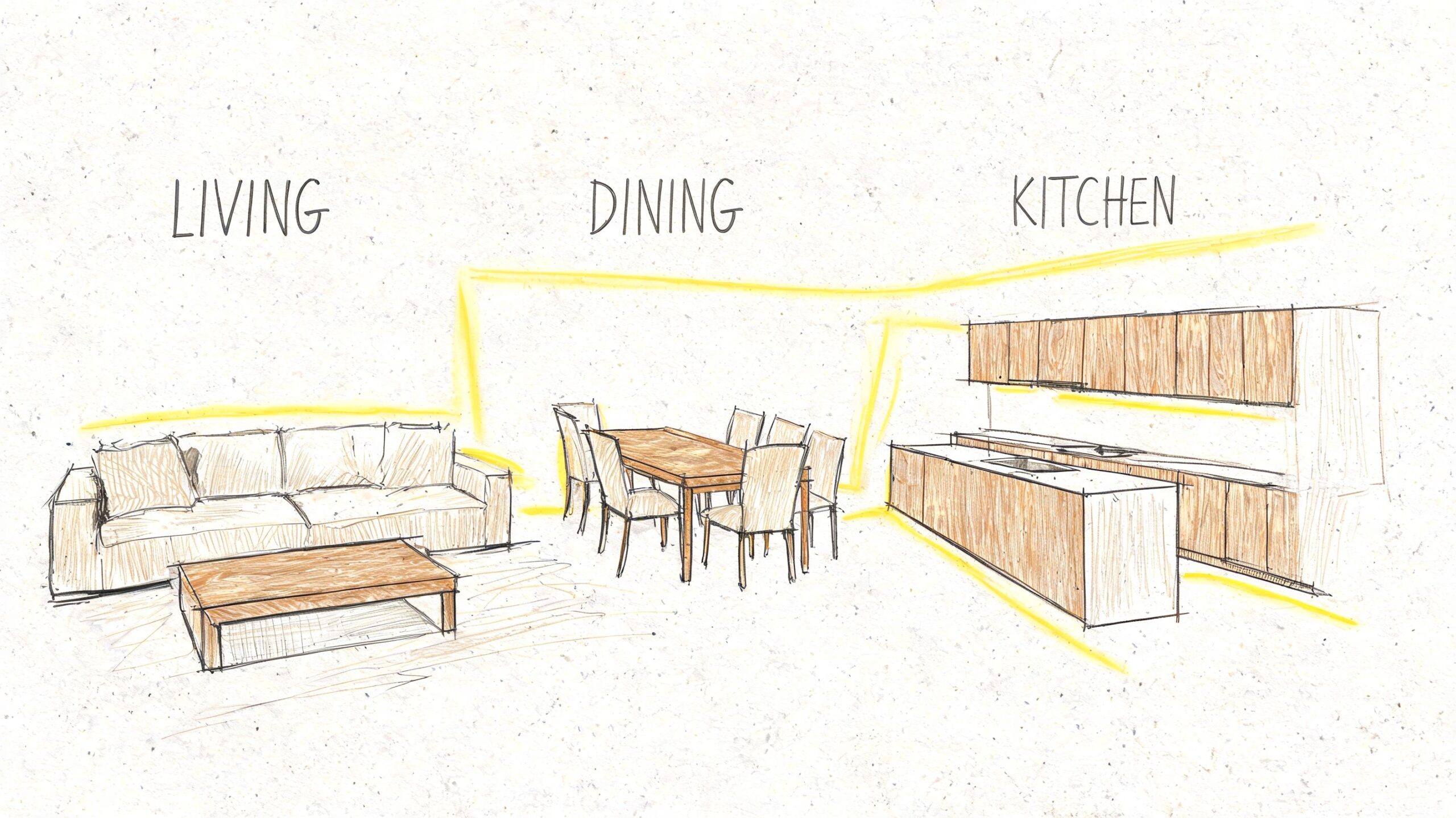
Use a simple palette you can repeat
One of the easiest ways to learn how to decorate an open floor plan is to stop reinventing the palette in every corner.
The 60-30-10 approach is useful here:
- 60% neutral base for walls and larger upholstery
- 30% secondary texture or supporting tone through wood, flooring, drapery, or case goods
- 10% accent color repeated in smaller doses
That doesn't mean the room has to be beige or predictable. It means the eye needs familiar notes as it moves from kitchen to dining to living.
A few reliable ways to create that thread:
- Repeat a wood tone in the dining table, cocktail table, or console
- Carry one metal finish through lighting and small accents
- Echo a fabric color from the living room in dining chairs, barstools, or pillows
Texture keeps the room from feeling flat
Open spaces often have large hard surfaces. Flooring runs uninterrupted, cabinetry spans long walls, and the visual field is broad. Texture gives the eye places to rest.
Mixing texture works better than mixing too many colors. Try a woven rug, smooth leather or soft performance upholstery, painted wood, ceramic lamps, and linen-look drapery. If all the finishes are smooth and shiny, the room feels cold. If every piece shouts for attention, the room feels noisy even before anyone turns on the television.
Our guide to building the perfect color palette is a helpful starting point if you're trying to connect fabrics, paint, and wood finishes before ordering furniture.
Design note: In an open room, restraint reads as confidence. Repetition makes the space feel intentional.
Light each zone separately
Lighting should follow function. One ceiling fixture in the middle of a large open room rarely works well.
Think in layers:
| Lighting layer | What it does | Good placement |
|---|---|---|
| Ambient | General illumination | Ceiling fixtures, recessed lighting |
| Task | Helps with specific activity | Pendants over islands, lamp by reading chair |
| Accent | Adds mood and depth | Art lights, buffet lamps, small table lamps |
A pendant over the dining table tells the eye that a dining zone lives there. Lamps in the living area lower the room emotionally and make it feel more intimate at night. Kitchen task lighting keeps the work areas bright without forcing the whole room into one flat level of light.
Complimentary in-store design assistance can be especially useful at this stage. Pulling together paint chips, upholstery swatches, wood samples, and lighting finishes in person often prevents the mismatch that makes an open floor plan feel disjointed.
Smart Solutions for Storage and Traffic Flow
Open plans look beautiful when they're tidy, but they don't give you many places to hide everyday life. Bags, mail, toys, throws, chargers, and serving pieces all need a home. If they don't have one, the whole room feels cluttered fast because everything is visible from everywhere.
Storage and flow have to be handled together. A beautiful room that blocks movement won't stay beautiful for long.
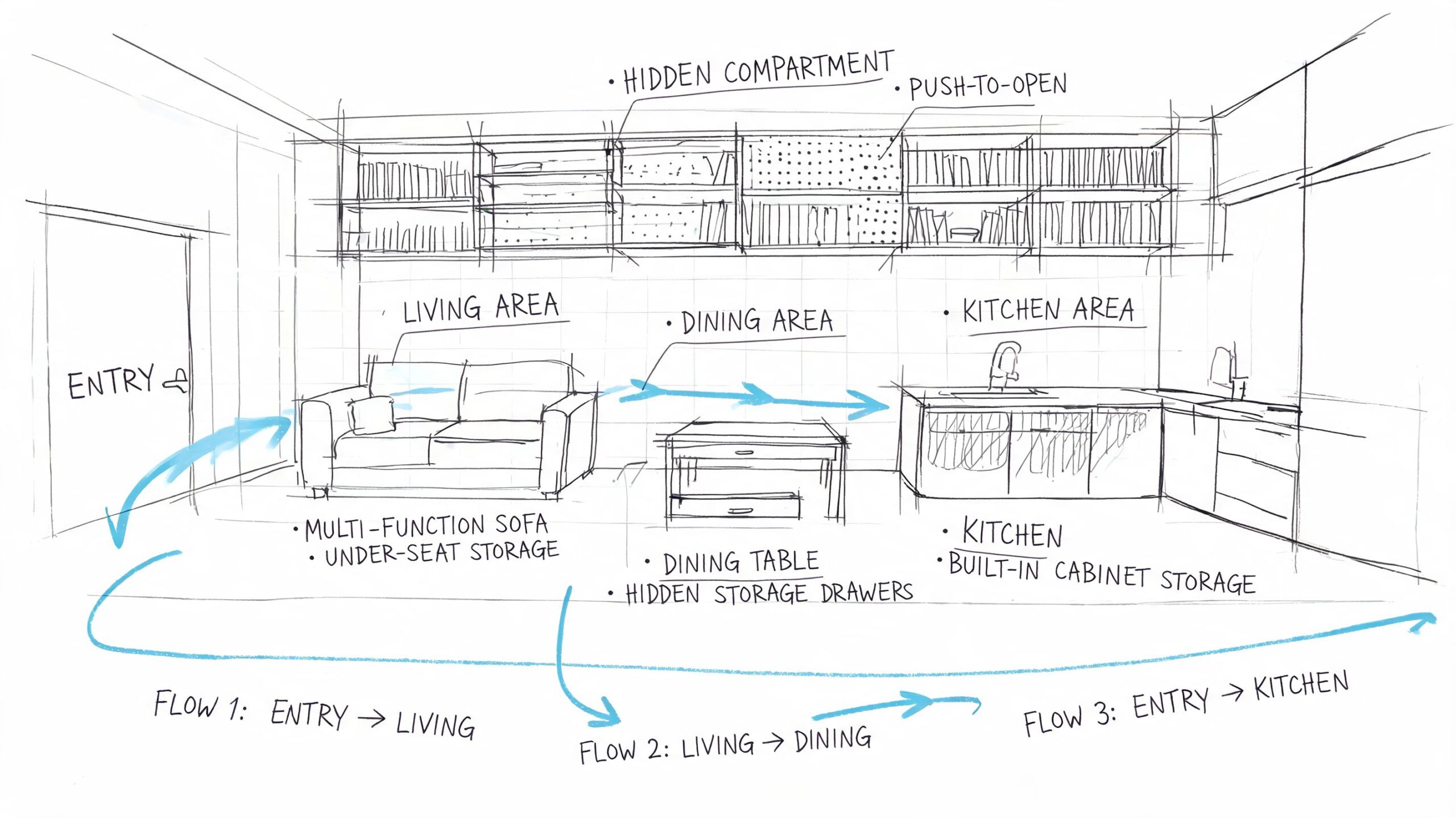
Add storage where the room naturally needs a boundary
The most useful storage pieces in open plans often sit at the edge of a zone.
Consider these workhorses:
- Console behind a sofa for lamps, baskets, and a visual break between living and dining
- Credenza on a long wall for dishes, media storage, or family overflow
- Bookcase used carefully to suggest division without making the room heavy
- Storage ottoman or bench for flexible seating and hidden contents
American-made furniture earns its keep. A solid wood piece from a line like Kincaid brings weight, utility, and longevity. It isn't there for one season. It's furniture built for generations, not just a few seasons.
For readers trying to tame visible clutter, our article on how to solve clutter issues once and for all offers practical ideas that work well in connected living spaces.
Protect the pathways
The room should tell people where to walk without making them zigzag around furniture. Major routes, especially from entry to kitchen or kitchen to living area, need to stay clear.
Common trouble spots include:
- A sectional that juts too far into the main path
- Dining chairs that back into a walkway
- Accent tables that look nice but pinch circulation
- Barstools placed where they crowd a pass-through
If a room feels awkward, traffic is often the hidden reason.
Handle angled walls without fighting them
This is one of the least discussed open-plan problems, and it matters more than people think. A National Association of Home Builders study cited here notes that 28% of new U.S. homes feature non-standard geometries, including angled walls.
An angled wall can make standard furniture look slightly off, especially if you try to force everything parallel to one surface. The better move is usually to choose one dominant alignment for the main seating group, then let smaller pieces absorb the angle. A swivel chair, a custom sectional, or a well-sized cabinet can often solve what a generic furniture set cannot.
Some walls should be acknowledged, not obeyed. If an angle throws off the whole room, anchor the main grouping to the strongest line in the space and let secondary pieces bridge the difference.
Your Open Floor Plan Solved by the Watts Design Center
Most homeowners don't need more inspiration. They need a plan that removes uncertainty.
Open floor plans ask you to make several decisions at once. Layout, scale, upholstery, finish, lighting, traffic, and storage all affect each other. That's why design help matters most in open-concept homes. One good decision supports the next one. One wrong one tends to echo across the whole room.
When complimentary guidance is enough
Sometimes the layout is already close, and the room just needs help pulling together.
A family in West Point might come in with a sofa they like, a chair they want to keep, and a question about how to stop the room from feeling pieced together. In that case, Complimentary In-Store Design Assistance can be the right level of help. Fabrics can be compared side by side. Wood finishes can be narrowed down. A repeat color can be chosen for pillows, rugs, or accent upholstery so the living and dining areas relate to each other.
That kind of guidance is practical because it answers the questions that stall a project:
- Which fabric works with kids and pets?
- Which wood tone won't fight the flooring?
- Which chair shape adds interest without making the room feel crowded?
When a full design plan makes more sense
Other homes need a more complete roadmap.
A homeowner in Hogansville with an oversized great room, angled walls, and multiple traffic paths may need more than fabric advice. That's where the Premium Design Service comes in. It allows for space planning, mood boards, and a full-room approach so the furniture isn't selected one isolated piece at a time. The deposit is credited back toward the purchase, which makes the process easier to justify when you're furnishing major zones at once.
This service is especially useful when you're choosing:
- American-made Bassett furniture
- Custom La-Z-Boy recliners or sectionals
- Dining, living, and accent pieces that need to work together across one open view
Why local support changes the experience
Open-plan projects are easier when someone can see the room dimensions, hear how your family uses the space, and recommend pieces that fit both function and style. That beats guessing from thumbnails online and hoping the scale works when the boxes arrive.
The practical advantages matter:
- Custom furniture selections in fabrics, leathers, and finishes
- White-glove delivery and setup
- A Service Request and Support Hub when you need help after the sale
- Guidance that reflects real homes in LaGrange, Troup County, West Point, Pine Mountain, and Hogansville
If you're ready for a starting point, you can book a free interior design consultation and get help sorting out layout, palette, and furniture choices before you commit.
An open floor plan doesn't need to feel loud, exposed, or unfinished. With the right zoning, right scale, and right materials, it can become the most useful and welcoming part of the house.
Visit Watts Furniture & Mattress at 212 Commerce Avenue in LaGrange to experience the comfort of La-Z-Boy in person. Ready to transform your space? Book a consultation with our Interior Design Center today and let us help you curate a home you’ll love.