Find Your Perfect Mattress with Our Guides

How to Choose a Recliner Sofa: Expert Guide


You’re probably doing what most families do. You sit down at night, open six browser tabs, and start comparing recliner sofas that all look comfortable until the details get muddy. One says “space-saving.” Another says “power lumbar.” A third looks great online, but you still can’t tell whether it will fit your room, your back, or your spouse’s longer legs.
That’s where people make expensive mistakes.
A recliner sofa isn’t just another seat in the house. It becomes the seat. It’s where you watch the game, recover after a long day, host family at Christmas, nap on Sunday afternoon, and settle in when your back tells you a standard sofa isn’t cutting it anymore. If you choose well, you’ll enjoy it for years. If you choose poorly, you’ll fight the room, the mechanism, and the comfort every single day.
I’ll give you the straight answer on how to choose a recliner sofa. Start with the room. Then measure the reclined footprint. Then decide on the mechanism. Then inspect what’s under the upholstery. Last, and this is the part most stores skip, make sure it fits the people who will use it.
Finding More Than Just a Sofa A Lifelong Investment
A good recliner sofa has to do three jobs at once. It needs to support your body, suit your room, and hold up to everyday living. If it misses even one of those, you’ll feel it fast.
Around LaGrange, West Point, Pine Mountain, and across Troup County, I see the same pattern. Folks shop by color first, then price, then size. That’s backwards. Start with function. A recliner sofa has moving parts, a deeper footprint, and a bigger effect on posture than a standard sofa. It has to earn its place in your home.
What a smart buyer looks for
The right piece should offer:
- Comfort that lasts: Not a soft seat for five minutes in a showroom, but support you still appreciate after a long evening.
- A frame and cushion build that can handle daily use: Premium construction plays a key role.
- A shape that fits your floor plan: Reclining furniture changes how a room works.
- Options that match your household: Kids, pets, older parents, tall adults, shorter adults, and overnight guests all put different demands on a sofa.
Practical rule: Buy for the way you live on an ordinary Tuesday, not the way you want the room to look in a catalog.
That’s why I lean toward furniture built for generations, not just a few seasons. Cheap reclining furniture can look decent from ten feet away. But inside, it often cuts corners on foam, support, and mechanisms. You don’t notice that on day one. You notice it when the seat starts collapsing, the footrest gets stubborn, or one side becomes everyone’s “bad seat.”
The decision that matters most
The best recliner sofa isn’t the one with the most features. It’s the one that solves the most problems in your home.
If you’re furnishing a busy family room, your priorities should be durability, easy-clean upholstery, and independent seating comfort. If you’re outfitting a quieter space, you may care more about a cleaner silhouette, leather, or a smoother power recline. Either way, the goal is the same. Buy something that feels right now and still makes sense years from now.
Start With Your Space and Your Story
Friday night hits. One person wants feet up for a movie, one wants firmer support for reading, a teenager sprawls sideways, and Grandpa needs a seat he can get out of without a struggle. That is how recliner sofa decisions really get made. Not by fabric swatches alone, and not by what looks good under showroom lights.

Start with the room, then the people, then the sofa. In that order.
A recliner sofa for a busy family room should solve daily problems. It should let different people sit their way without turning one seat into the only comfortable spot in the house. A young couple in Hogansville may need one sofa that handles TV, naps, guests, and spills. A retired homeowner in Pine Mountain may care more about steady support, easier entry and exit, and clear walking space around the furniture.
So quit asking, “What’s the best recliner sofa?” Ask, “What does this room need to do, and who needs it to do it well?”
Ask these questions before you shop
Stand in the room and answer these plainly:
- Who uses this sofa every week: One person, a couple, kids, overnight guests, or three generations at once?
- How do they sit: Upright, fully reclined, curled in the corner, or stretched out for two-hour movies?
- Do the people in your home have different heights and builds: A sofa that fits a 6-foot-3 adult can feel lousy to someone who is 5-foot-2 if the seat depth, head support, and footrest position are off.
- Does anyone need easier support getting in or out: If yes, smooth operation and good seat height matter more than fancy extras.
- What else happens in the room: Reading, TV, conversation, napping, pet traffic, homework, or holiday overflow?
That height-and-build question gets missed all the time, and it causes more regret than color ever will. Families share sofas, but they do not share the same leg length, back length, or preferred sitting posture. If one seat fits Dad and another pinches Mom behind the knees, you do not have a good sofa. You have a future complaint.
Build around real life, not a showroom fantasy
A recliner sofa has to work with the habits in your house.
Maybe one person wants full recline for ball games while another wants a shallower angle with proper neck support. Maybe your father-in-law visits twice a week and needs a seat that feels steady when he stands. Maybe your kids use the living room like mission control, with snacks, chargers, blankets, and a dog thrown in for good measure. Those details should drive the decision.
Custom furniture can make good sense here. It gives you more control over configuration, seat feel, and upholstery so the sofa suits your household instead of forcing everybody into the same compromise.
Rooms tell the truth fast. If a recliner sofa blocks movement, creates one “good seat,” or fits only one body type, it is the wrong piece no matter how sharp it looks online.
Before you shop in person, use a practical room planning guide like this furniture measuring guide for your room so you’re working from real dimensions and real daily use.
Measure Twice to Ensure a Perfect Fit
Most recliner sofa mistakes start with bad measuring. Not bad taste. Not even bad quality. Just bad measuring.
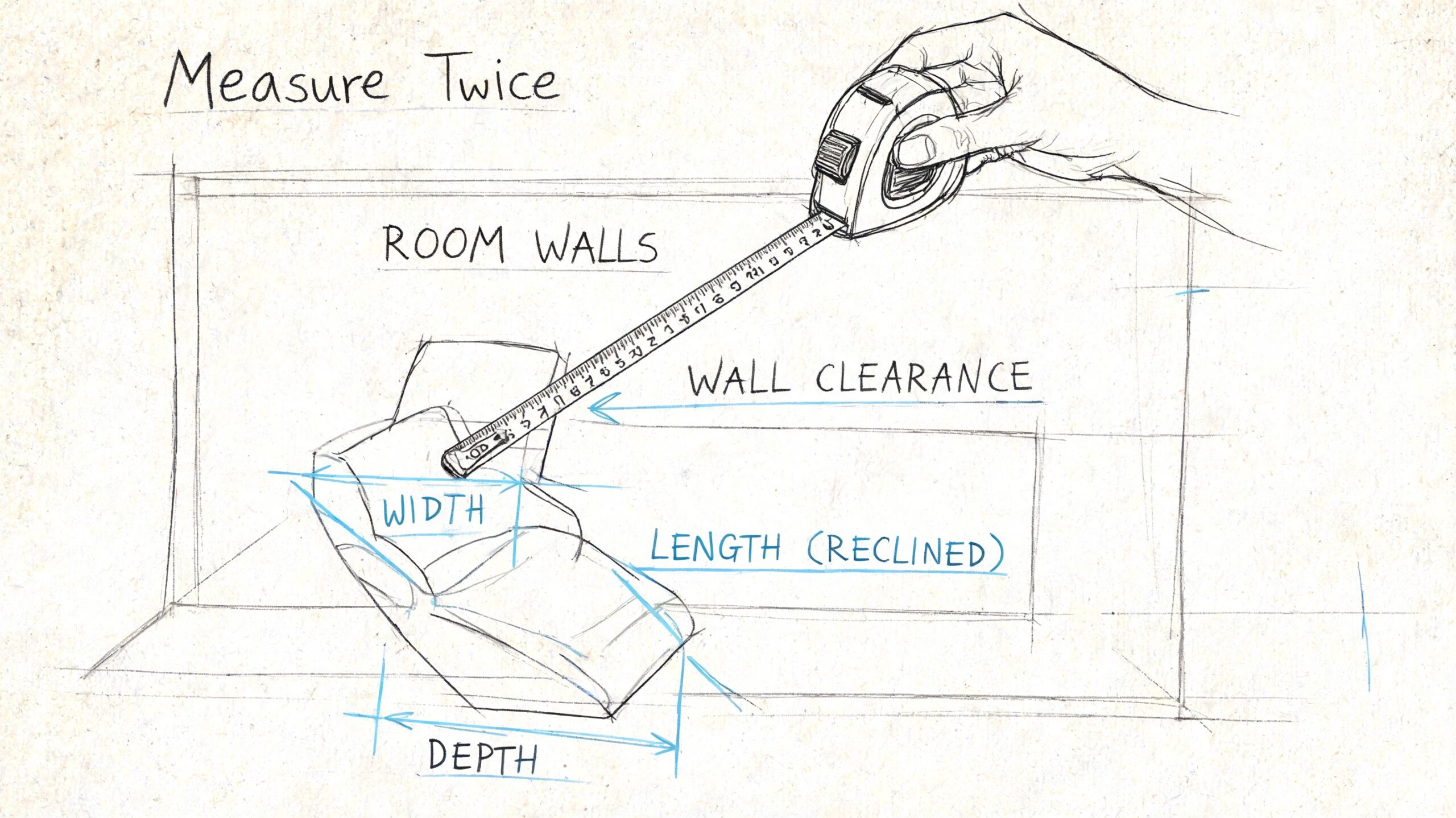
People measure wall width and stop there. That’s not enough for reclining furniture. You have to measure the sofa upright, fully extended, and along the path it takes to get into the house.
Measure the room like a furniture pro
Start with the obvious dimensions, then move to the ones people forget.
- Measure the wall space where the sofa will sit.
- Measure traffic paths to nearby doors, end tables, fireplaces, and walkways.
- Measure the delivery path from your front door to the final room. Check entry doors, stair turns, hallways, and tight corners.
- Mark the footprint on the floor with painter’s tape. Do this before you buy anything.
That tape trick saves people from all kinds of regret. It lets you see whether the sofa crowds a coffee table, narrows a walkway, or makes the room feel pinned down.
Don’t guess at recline clearance
This part matters. Standard recliner sofas typically need 36-40 inches of depth when reclined, while modern wall-hugger designs can achieve a full 140-degree recline with as little as 2 inches of backspace and 20 inches in front (Povison reclining sofa guide).
That’s why a wall-hugger can be a smart choice in homes where every inch matters. In a tighter room, it often solves the problem without forcing you to give up reclining comfort.
Here’s a quick comparison:
| Measurement concern | Standard recliner sofa | Wall-hugger recliner sofa |
|---|---|---|
| Reclined depth | Needs more floor depth | Better for tighter layouts |
| Wall clearance | More space behind required | Can work with minimal back clearance |
| Small room suitability | Depends on layout | Often the better choice |
If you can’t recline it without shifting the coffee table or blocking the walkway, it doesn’t fit. It only technically fits.
For a more detailed checklist, use this furniture measuring guide before you commit. It’s a lot cheaper to measure one more time than to wrestle a sofa that never should’ve been ordered.
Power vs Manual Mechanisms and Configurations
Once the size works, turn your attention to the mechanism. The mechanism determines whether comfort becomes daily convenience, or daily irritation.
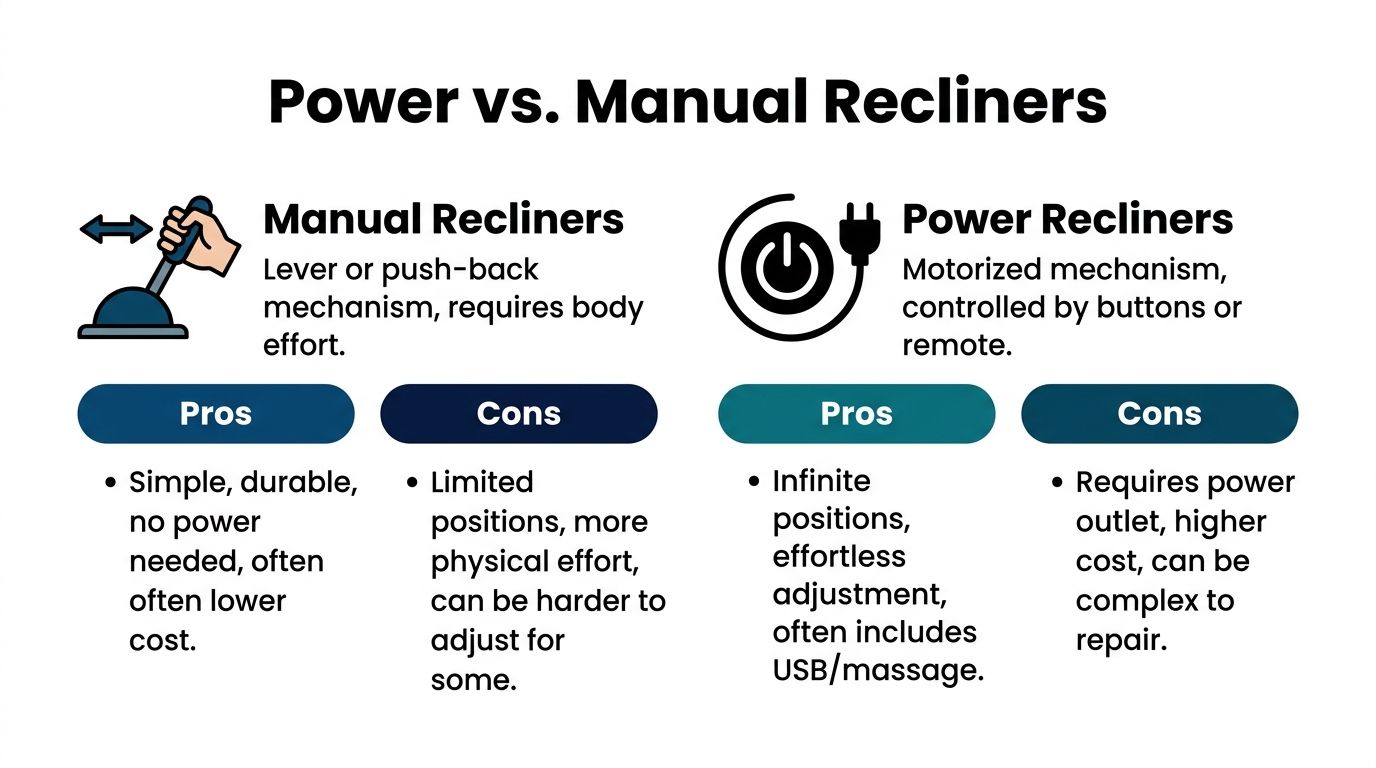
Some shoppers assume power is always better. Others insist manual is the only reliable option. The choice is simpler. The right mechanism depends on who’s using the sofa, how often they recline, and whether easy adjustment matters more than simplicity.
Manual recliners make sense when simplicity wins
A manual recliner usually uses a lever or push-back motion. I recommend manual when the buyer wants fewer complications, doesn’t want to depend on outlet placement, or prefers a straightforward mechanism.
Manual recliners are a strong fit for:
- Frequent movers: No cords, no outlet planning.
- Secondary rooms: Great for bonus rooms, cabins, or less-used spaces.
- Buyers who prefer mechanical simplicity: Fewer powered features means a more basic setup.
A good manual recliner sofa can still feel substantial and comfortable. It just won’t give you the same fine-tuned position control that a power model offers.
Power recliners are worth it for tailored comfort
A power recliner earns its keep when comfort needs are more specific. If one person needs better leg elevation, another wants a slightly raised headrest, or someone in the house struggles with a manual lever, power is the better answer.
In the premium category, Custom La-Z-Boy recliners and Bassett recliners stand out. They often offer cleaner motion, easier adjustment, and features that make long sitting sessions much more comfortable.
Power tends to suit:
- Households with mobility needs
- People who use the sofa daily for longer stretches
- Couples who don’t like the same recline position
- Shoppers who want extras like USB charging and adjustable support
For shoppers comparing features in more detail, this guide to power reclining seating lays out the common options clearly.
Pick the right configuration for the room
Mechanism is only half the choice. Configuration matters just as much.
A reclining sofa works well for many living rooms, but it isn’t the answer for every layout. Sometimes a reclining loveseat and separate chair fit better. Sometimes a living room sectional gives the family enough seating without forcing a too-long sofa across one wall.
I usually break it down like this:
- Choose a reclining sofa when the room needs a clean, centered seating anchor.
- Choose a loveseat when the room is compact or used by two people most of the time.
- Choose a sectional when the room is larger and family gathering space matters more than formal symmetry.
Buy the configuration that protects the room’s flow. A recliner sofa should make the room easier to use, not harder.
Look for Quality Inside and Out
If you want a recliner sofa that lasts, stop focusing only on the cover. Its true quality is inside the seat, inside the frame, and inside the mechanism housing.
Plenty of recliner sofas look impressive on the sales floor. Sit on them long enough and the weak ones reveal themselves. The seat loses shape. The back gets hollow. The arm starts to wobble. That’s not bad luck. That’s bad construction.
What matters under the upholstery
For longevity, look for high-density foam of at least 2.0 lbs/ft³ and frames built for durability. Material choice matters too. Full-grain leather can last 15-25 years, while performance fabrics with over 10,000 Martindale cycles resist 95% of household spills. The same guidance notes that 68% of returns stem from poor material or size choices (Finn and Form recliner sofa guide).
That tells you something important. People don’t just buy the wrong color. They buy the wrong build.
If you’re shopping premium upholstery and want to understand the tradeoffs better, this upholstery materials guide is useful for comparing feel, wear, and upkeep.
American-made quality is still the standard
I’m opinionated on this. If you want American-made furniture that’s built with long-term ownership in mind, pay attention to brands known for stronger frames and more thoughtful construction. Bassett and Kincaid are the kind of names people look at when they want solid wood heritage and a more lasting feel.
That doesn’t mean every room needs the fanciest option. It means your money should go toward the bones of the piece before it goes toward flashy extras.
Here’s the upholstery comparison most families need.
Upholstery Showdown Leather vs Performance Fabric
| Feature | Genuine Leather | Performance Fabric |
|---|---|---|
| Durability | Long-wearing and resistant to everyday wear | Strong option for active households |
| Spill behavior | Wipes up quickly in many cases | Built to handle common household messes |
| Pet hair and allergens | Doesn’t trap pet hair or dust the way many fabrics do | Depends on weave and finish |
| Feel | Smooth, tailored, and often more structured | Softer, warmer, and often more casual |
| Maintenance | Needs proper leather care | Usually easier for everyday spot cleaning |
| Best fit | Adults, pet owners, and buyers wanting a refined look | Busy family rooms and homes with kids |
The upholstery should match the room’s workload. Don’t put a delicate cover on a hard-working family sofa and expect a happy ending.
The Ultimate Test Comfort for Everyone in the Family
This is the part most recliner advice gets wrong. A sofa can be well made, well priced, and still be wrong for your house if it only fits one person comfortably.
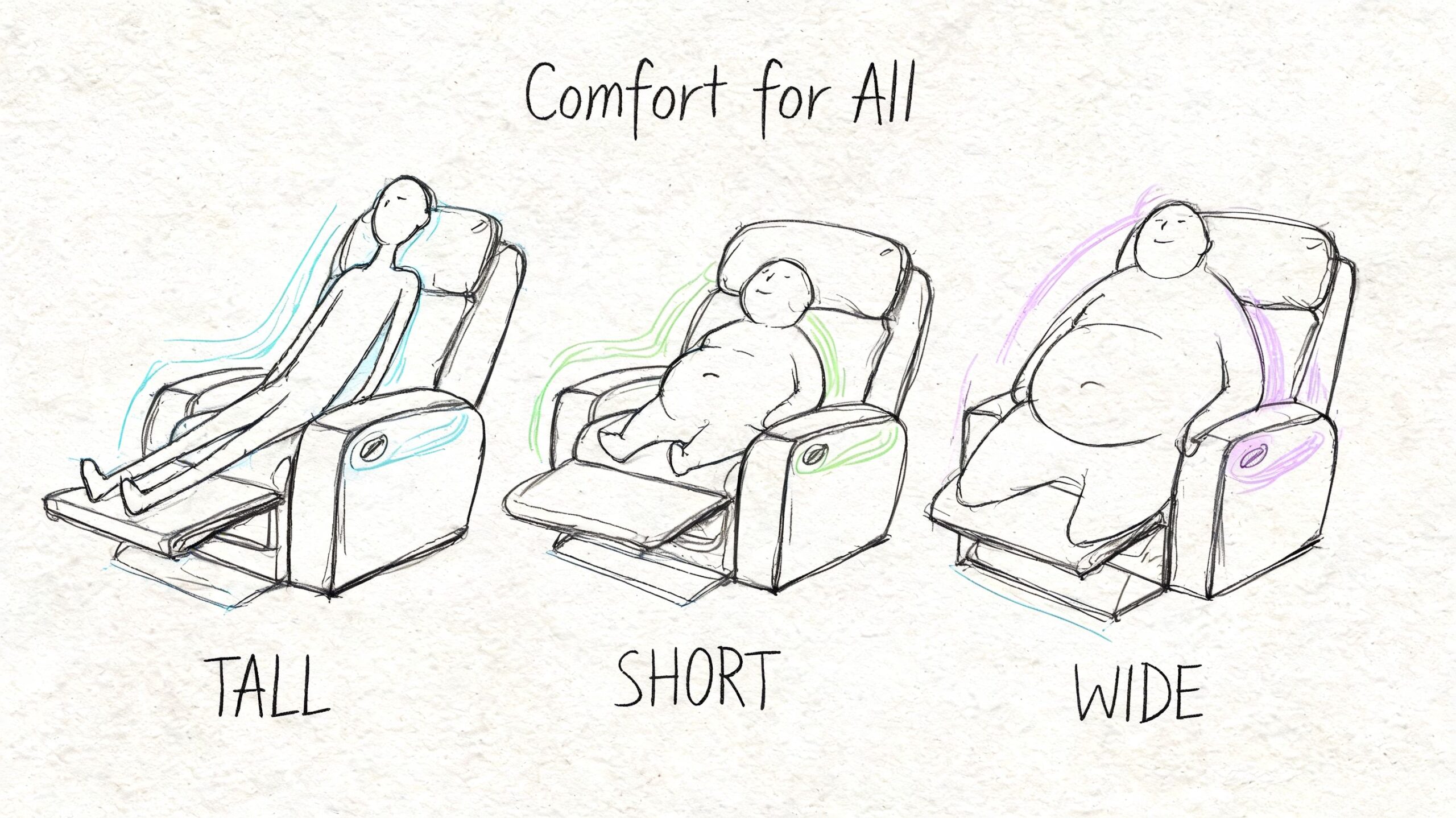
Shared recliner sofas fail when couples or families assume “comfortable enough” for one person will work for everybody. It often doesn’t. A shorter person may feel the seat hits the back of the knees wrong. A taller person may find the footrest too short. One person’s neck gets proper support while another’s head tips forward.
That’s not a small issue. A 2025 ergonomics report found that 62% of recliner sofa returns are due to poor body fit in shared households. Sofas with independent reclining seats and adjustable lumbar and headrests can reduce user dissatisfaction by 40% (Dweva power reclining sofa guide).
Use a real in-store testing checklist
Don’t just sit down and say, “That feels nice.” Test it like you plan to live in it.
Check these points:
- Lower back contact: Your back should meet the lumbar area naturally. You shouldn’t have to scoot, slump, or brace.
- Seat height: In the upright position, your feet should rest comfortably on the floor.
- Seat depth: Your hips should sit fully back without pressure forcing you forward.
- Head and neck support: When reclined, the headrest should support your neck without pushing your chin down.
- Leg support: The footrest should support the legs in a way that feels natural, not shortened or overextended.
- Ease of operation: Every user should be able to work the mechanism comfortably.
Test it with the people who matter
If two adults will share the sofa, both should test it. If one person is much taller or shorter, don’t assume adjustment features will fix everything. Verify it.
I strongly favor recliner sofas with independent reclining seats in mixed-height households. If your budget allows, adjustable headrests and lumbar support are worth serious attention because they help one sofa serve more than one body type.
A strong showroom test looks like this:
- Sit upright for several minutes.
- Recline to your preferred position.
- Stay there long enough to notice pressure points.
- Switch seats and repeat.
- Have the second primary user do the same.
Comfort is personal. If the sofa only fits the average person in theory, it won’t satisfy the real people in your house.
If back support is a major concern, this recliner guide focused on back support is worth reading before you make a final decision.
Bringing Your Perfect Recliner Sofa Home
By the time you buy, the decision should feel settled. You have already checked the size, tested the mechanism, and made sure the sofa works for the people who will use it. That last part matters more than shoppers think. A recliner sofa can look perfect in a showroom and still frustrate a tall husband, a petite wife, or a teenager who ends up with no head support in the “good seat.”
Finish strong. The purchase process can protect a smart decision, or ruin it.
Finish the purchase the smart way
A few final details deserve real attention:
- Delivery and setup: Recliner sofas are heavy, mechanical pieces. Professional white-glove delivery and setup help protect the frame, the mechanism, and your doorways, floors, and walls.
- Warranty and service support: Ask who handles service if a mechanism needs adjustment later. Get a clear answer before you pay.
- Budget flexibility: If financing lets you buy the right sofa instead of a short-term substitute, use it with discipline. 0% APR financing can make sense when available.
- Fabric and leather selection: Slow down here. A strong frame with the wrong cover still becomes the wrong sofa for your household.
Use design help if the room is complicated
Some rooms are easy. Four walls, one traffic path, neutral finishes.
Others are not. You may be matching wood tones, working around a fireplace, dealing with an open floor plan, or trying to make a large recliner sofa fit without crowding the room. Good design help saves time and prevents expensive mistakes.
The Interior Design Center approach is practical because it offers two levels of support:
- Complimentary In-Store Advice for help narrowing fabric, color, and layout choices
- Premium Design Service for full-room planning, including layouts and mood boards, with the deposit credited toward your purchase
That kind of help is useful when one sofa has to satisfy several people and still look right with the rest of the room.
There is also real value in local service after the sale. A showroom such as Watts Furniture & Mattress gives shoppers a place to test products in person, ask design questions, arrange delivery and setup, and request service later if needed. That is a better path than guessing online and hoping the sofa fits your family once it reaches the house.
Choose carefully, and your recliner sofa will do more than fill a room. It will become the seat everyone reaches for, year after year.